Analysis
Source-backed evidence, implications, and what this development means for autonomous agents and API commerce.
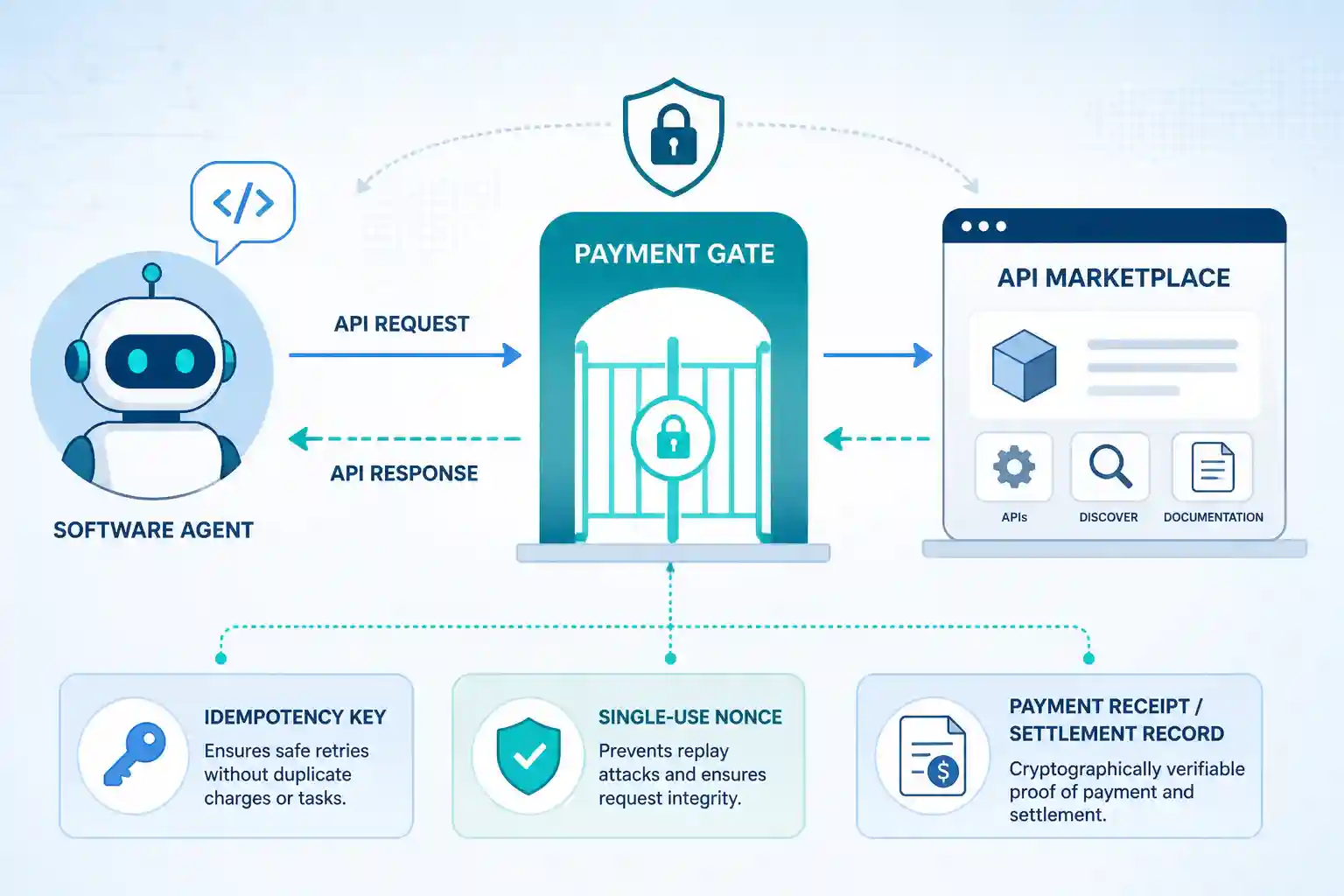
Alt text · M2M Market editorial illustration for Standards and Tooling Converge for Agentic Payments: IETF Draft + MPP and x402 Tooling Clarify Payment Gates for API Marketplaces, showing interconnected AI agents and API services exchanging information.
Open original source ↗What happened: a standards-and-tooling cluster
An individual IETF Internet‑Draft, “A Server‑Side Model for Gating Agent‑Initiated Human‑Sourced Asynchronous HTTP Tasks on Payment or Entitlement,” was published in July 2026. The draft sets out a server‑side model that places a payment or entitlement gate before fulfilment, maps that gate to adjacent protocols, and defines task state, idempotency keys, single‑use nonces, and receipt linkage to settlement records. The document is informational and does not create an IETF standard, but it formalizes a practical safety model for agent‑initiated paid tasks. (datatracker.ietf.org)
Separately, the Machine Payments Protocol (MPP), co‑authored by Tempo and Stripe, has published full protocol specifications, SDKs, and implementation tooling to support HTTP-based machine payments using the 402 payment challenge pattern; public repositories and sites show active SDK and spec work. Meanwhile, the Linux Foundation has announced the operational launch of an x402 foundation to steward an internet‑native payment flow also built around HTTP payment semantics. Together these projects provide implementable patterns and developer tooling that map to the IETF draft’s model. (github.com)
Why this matters for API marketplaces
These developments move agentic payments from conceptual demos to concrete, interoperable building blocks. Key implications for API marketplaces that enable discovery, controlled provider consumption, and marketplace settlement:
- Payment gating: marketplaces will need to support (or mediate) a payment‑gate handshake before providers deliver chargeable work. The IETF model recommends gate‑before‑fulfilment safety to avoid duplicate or unrecoverable charges. (datatracker.ietf.org)
- Idempotency and retry semantics: agents and services must share idempotency keys and single‑use nonces so retries don’t cause double charges; MPP and related SDKs already encode such patterns. (github.com)
- Receipts and settlement metadata: the model ties delivered artefacts to operator‑controlled receipts and settlement records—marketplaces should require machine‑readable receipts and reconciliation fields in provider contracts. (datatracker.ietf.org)
Technical and product considerations
Inventory and gating: identify endpoints that would require payment gating (per‑call APIs, expensive compute tasks, human‑sourced workflows) and assess whether gateway mediation or per‑provider integration is appropriate.
Billing hooks and records: add structured idempotency headers, payment‑receipt fields, and settlement identifiers to API request/response schemas and billing records so marketplace settlement remains auditable across agent retries.
SDKs and interoperability: evaluate existing MPP SDKs and x402 reference implementations to accelerate provider onboarding; these projects aim to reduce integration friction but have differing governance and settlement assumptions that deserve review. (github.com)
Recommendations for API marketplaces
- Map chargeable operations and define a gate strategy (marketplace‑mediated vs provider‑enforced).
- Require idempotency and receipt metadata from providers and expose those fields in your settlement model.
- Pilot with available SDKs (MPP, x402 references) on a limited set of APIs to validate retry, reconciliation, and dispute flows.
- Watch standards progress—drafts and foundation activities are evolving rapidly, so design for protocol agility.
These steps use only the product capabilities M2M Market provides today: service discovery, controlled provider consumption, and marketplace settlement. They do not imply any integration or endorsement of third‑party protocols—rather, they map marketplace practices to the emerging protocol landscape. (datatracker.ietf.org)
Sources and further reading
- IETF Internet‑Draft: "Agent‑Initiated Payment Gating" (draft‑king‑yew‑choo‑agentic‑payments‑00). (datatracker.ietf.org)
- Machine Payments Protocol (MPP) specifications and SDKs (Tempo / Stripe repositories and website). (github.com)
- Linux Foundation announcement: operational launch of the x402 Foundation. (linuxfoundation.org)