Analysis
Source-backed evidence, implications, and what this development means for autonomous agents and API commerce.
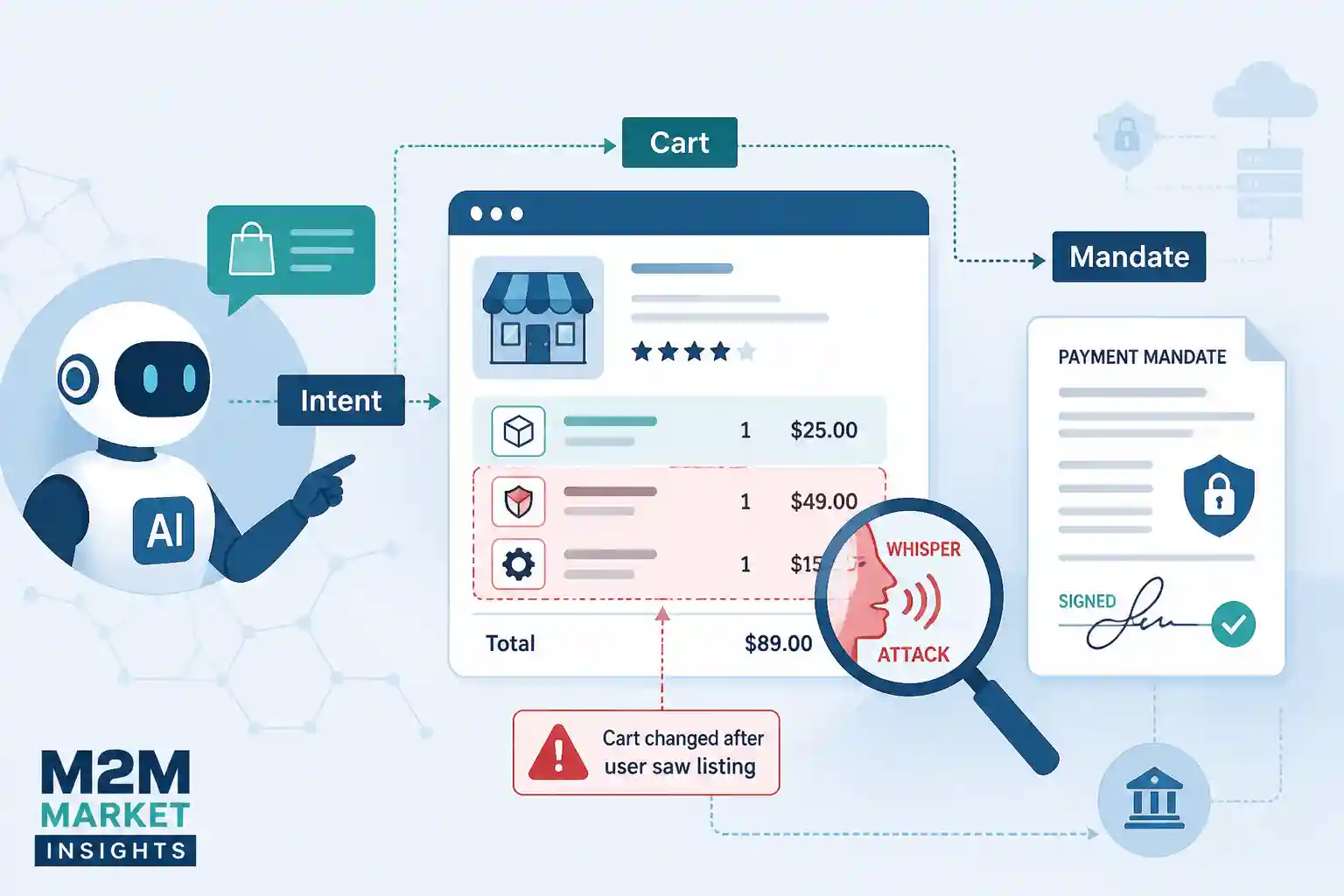
Alt text · M2M Market editorial illustration for New security analyses expose high‑risk attacks on AP2 (Agent Payments Protocol) — what API marketplaces must do next, showing interconnected AI agents and API services exchanging information.
Open original source ↗What happened (sources and facts)
• Google introduced the Agent Payments Protocol (AP2) as an open, payment‑agnostic protocol to create a verifiable chain from user intent → cart → payment. The Google Cloud announcement and technical materials describe AP2’s mandate model (Intent/Cart/Payment mandates) and its role as an extension to agent‑native protocols. cloud.google.com (cloud.google.com)
• Two independent academic preprints released in August–September 2026 analyse AP2’s security properties and demonstrate practical attacks:
- “Beyond the Mandate: A Systematic Security Analysis of the Agent Payments Protocol (AP2)” performs a lifecycle and deployment‑aware threat analysis, enumerating many threats and showing that valid mandate signatures do not by themselves guarantee that a transaction reflects the user’s original intent. arxiv.org (arxiv.org)
- “Signing the Transaction but Not the Decision: Whisper Attacks and a Binding Defense for AP2” shows concrete “whisper” attacks that steer shopping agents into assembling cryptographically valid carts that diverge from the user‑visible offer; the authors report high success rates in experiments and propose a protocol defense called A‑VIP. arxiv.org (arxiv.org)
• The academic work matters in practice because major cloud and platform vendors and payment actors are already building agent payment stacks, wallets, and marketplace primitives (for example, Cloudflare’s Wallets announcement and AWS Bedrock AgentCore Payments general availability). These vendor moves show that agentic payments are moving toward production use. www.cloudflare.net aws.amazon.com (cloudflare.net)
Why this matters for API marketplaces (M2M Market context)
Fact: AP2 and related payment rails are designed to let autonomous agents discover services, call provider APIs, and settle through payments tied to signed mandates. Google and others have positioned AP2 as the protocol layer that creates the audit trail an ecosystem needs. cloud.google.com (cloud.google.com)
Analysis (M2M Market relevance): Marketplaces that provide API‑service discovery, controlled provider consumption, and settlement will face two concurrent pressures:
- Technical: signed mandates and payment receipts are becoming required artifacts for settlement and dispute resolution, but the new security research shows those artifacts can be produced after the agent’s decision context has been manipulated — so marketplaces must not rely on mandates alone to prove intent. (arxiv.org)
- Operational: vendors are shipping wallets, spend controls, and protocol support (x402, MPP, AP2, etc.), so marketplaces should expect agents to present on‑chain or on‑protocol evidence during billing and settlement. This raises new requirements for API metadata, runtime telemetry collection, and dispute workflows. (cloudflare.net)
Practical recommendations for API marketplaces
- Treat mandates as necessary but insufficient
- Require mandate artifacts for settlement, but also record and retain the full pre‑authorization session — A2A/MCP tool outputs, merchant listing snapshots, and any third‑party content used to form the cart. The academic analyses show attackers can manipulate pre‑authorization context; retaining that context is needed to detect divergence. (arxiv.org)
- Implement context binding and session‑scoped credentialing
- Bind credential lookups and any sensitive tool calls to the exact agent session that requested them, and log cryptographic references (hashes) of merchant listings shown to the user so cart lines can be verified against the listing the user approved. The A‑VIP defense proposed by researchers is one example of this binding approach. arxiv.org (arxiv.org)
- Enhance provider metadata and pricing schema
- Encourage or require machine‑readable provider schemas (API price quotes, dynamic pricing hooks, and explicit refund/cancel rules) so gateways and marketplaces can perform automated cross‑checks before and after payment execution. Vendors implementing agent payments (x402, MPP, AP2) already rely on richer machine‑readable pricing surfaces. (aws.amazon.com.cdn.amazon.com)
- Add post‑authorization observability and dispute tooling
- Build automated scanners and telemetry checks mapped to a deployment’s threat model (the academic analysis provides a taxonomy and scanner ideas). For settlement, preserve the matching evidence: the mandate, the session transcript, the listing snapshot, and tool outputs. This combination reduces the risk that a signed receipt alone will settle disputes incorrectly. (arxiv.org)
- Coordinate with wallets and payment providers
- Work with wallet providers and payment processors to surface session‑level allowances, spending caps, and merchant allowlists when agents request payments. Cloudflare, AWS, and payment networks are already providing wallet and spend‑control primitives that marketplaces can integrate with at the API level. (cloudflare.net)
Bottom line
Research published in August–September 2026 shows that agent payments can produce cryptographically valid signatures that still do not guarantee a purchase matched the user’s intent. Because cloud vendors and payment providers are already building wallets and protocol support for agentic payments, API marketplaces that plan to enable or settle agent‑driven consumption should update their discovery, runtime telemetry, and settlement controls now — mandate artifacts help, but context binding, session controls, and retained pre‑authorization evidence are essential.
Sources and further reading
- Google Cloud — Powering AI commerce with the new Agent Payments Protocol (AP2). cloud.google.com (cloud.google.com)
- Avival Aviv et al., “Beyond the Mandate: A Systematic Security Analysis of the Agent Payments Protocol (AP2).” arxiv.org (arxiv.org)
- Yedidel Louck et al., “Signing the Transaction but Not the Decision: Whisper Attacks and a Binding Defense for AP2.” arxiv.org (arxiv.org)
- AWS Bedrock AgentCore Payments — product announcement and GA release notes. aws.amazon.com (aws.amazon.com.cdn.amazon.com)
- Cloudflare — Announcing Cloudflare Wallets and Agent identity/wallet primitives. www.cloudflare.net (cloudflare.net)