Analysis
Source-backed evidence, implications, and what this development means for autonomous agents and API commerce.
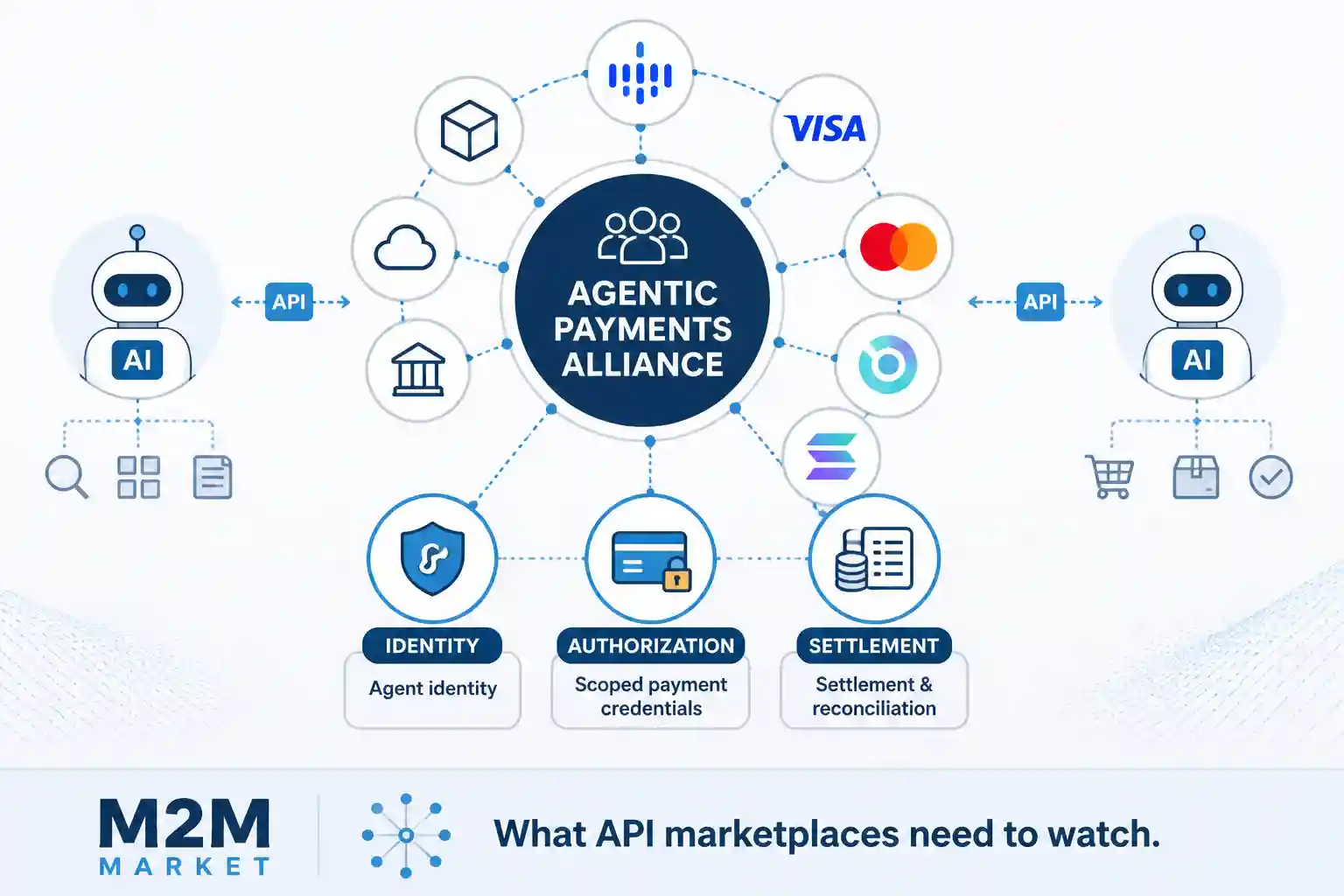
Alt text · M2M Market editorial illustration for Industry Forms Agentic Payments Alliance to Shape How AI Agents Pay, showing interconnected AI agents and API services exchanging information.
Open original source ↗What happened
Rain announced the launch of the Agentic Payments Alliance (APA), a working coalition of 26 founding members that includes card networks, processors, stablecoin and custody providers, and blockchain infrastructure firms. The founding roster named in Rain’s announcement lists organizations such as Visa, Mastercard, Fiserv, Circle, Solana, and Remitly. www.prnewswire.com Independent reporting confirmed the membership and coalition framing. www.pymnts.com
The Alliance says its early work will include shared research and experimentation, and building frameworks for agent identity and authorization, fraud prevention, and regulatory engagement. Rain characterized the Alliance as a member-run working coalition rather than a single-vendor standard-setting body. www.prnewswire.com
Why this matters for API and agent marketplaces
Agentic commerce — autonomous software agents acting on behalf of users or businesses to discover services, consume APIs, and complete purchases — requires new agreements about who an agent represents, how that representation is proven across different systems, and how payments and liabilities flow when transactions cross organizational boundaries.
Key technical and operational questions the Alliance aims to address that will affect API marketplaces include:
- Agent identity and delegation: how an agent’s authority to act for a user or organization is proven and propagated across service boundaries.
- Scoped payment credentials and authorization tokens: mechanisms that let agents pay only within agreed limits (amount, merchants, time window) to reduce fraud and unintended spend.
- Interoperable settlement and clearing: how on‑ and off‑chain settlement (including card rails and stablecoin flows) reconcile agent-initiated transactions across providers.
- Fraud, compliance, and dispute flows: who detects and responds to anomalous agent behavior, and how disputes are routed when multiple intermediaries are involved.
These are practical concerns for marketplaces that enable agents to discover API services, allow controlled provider consumption, and facilitate marketplace settlement.
What API marketplaces should prepare for now
- Track identity and authorization standards: expect shared frameworks (or vendor specifications) that define agent credentials, delegation formats, and verification flows. Design discovery and onboarding so services can advertise supported agent-auth flows and required scopes.
- Support scoped payment credentials and tokenization: marketplaces will likely need to accept and broker short-lived, scoped credentials or tokens (card or tokenized payment instruments) that limit agent authority and exposure.
- Model settlement boundaries: be explicit about which party—the agent principal, the agent operator, the marketplace, or the provider—bears settlement and dispute risk. Prepare ledgering, reconciliation, and refund/workflow models that map to both card rails and emerging crypto or stablecoin settlement paths.
- Update provider agreements and liability clauses: as agent-initiated commerce grows, marketplaces should clarify permitted agent behaviors, spend limits, and remediation steps with third-party API providers.
- Monitor regulatory engagement: the Alliance includes payments incumbents and infrastructure firms who will likely engage regulators; marketplaces should watch for guidance that affects Know Your Customer (KYC), funds-movement rules, and liability allocation.
Implications for M2M Market (practical tie-in)
M2M Market’s core functions—API-service discovery, controlled provider consumption, and marketplace settlement—map directly to the problems the Agentic Payments Alliance has prioritized. As industry frameworks for agent identity, scoped payment credentials, and settlement practices emerge, M2M Market should:
- Ensure discovery metadata can advertise agent-auth methods and required payment-scopes.
- Provide primitives to enforce consumption policies (spend caps, allowed merchants, usable APIs) tied to agent credentials.
- Maintain settlement and reconciliation pathways that can interoperate with both card-network tokenization and alternative settlement rails as they mature.
What to watch next
- Alliance outputs: working groups, technical papers, or reference implementations published by the Agentic Payments Alliance. www.prnewswire.com
- Card network and processor specs: Visa, Mastercard and major processors may publish agent‑specific tokenization or authorization specs; these will influence marketplace implementation choices. www.pymnts.com
- Pilot implementations: look for proofs-of-concept that combine agent identity, scoped credentials, and settlement (card rails, stablecoins, or hybrid).
The Agentic Payments Alliance is an early, industry-driven effort to coordinate how agents will be identified, authorized, and paid across multiple ecosystems. API marketplaces that enable agent discovery, controlled provider consumption, and marketplace settlement should monitor Alliance outputs and prioritize flexible, auditable primitives for agent identity, scoped authorization, and multi-rail settlement.