Analysis
Source-backed evidence, implications, and what this development means for autonomous agents and API commerce.
Alt text · M2M Market editorial illustration for How AI agents pay for APIs: rails, HTTP 402/x402, MPP, wallets, and recent pilots, showing interconnected AI agents and API services exchanging information.
Open original source ↗Why a dedicated payment layer matters for APIs and agents
Autonomous agents can discover and call paid APIs, but when a service requires payment the agent must do more than call an endpoint: it needs a way to learn the price, prove authority to spend, execute an on‑behalf payment, and receive an auditable receipt. Recent vendor and standards work shows the market is converging on layered solutions that separate discovery/intent from authorization and from settlement. (aws.amazon.com.cdn.amazon.com)
The protocol landscape — short primer
- HTTP 402 (x402): revives the HTTP 402 "Payment Required" status as an interoperable paywall handshake. The server responds with a 402 and a JSON payment requirement; the client constructs a signed payment authorization and retries the request with the signature; a facilitator (off‑chain or on‑chain) confirms settlement and the server returns the resource and an optional receipt. The x402 spec and reference implementations focus on stablecoin settlement (USDC on L2s) and facilitator workflows. (llmmart.ai)
- Machine Payments Protocol (MPP): an open, rail‑agnostic protocol co‑authored by Stripe and Tempo to let agents request, authorize, and complete payments using a variety of rails (stablecoins on payment chains, card rails via tokenization, Lightning, etc.). MPP is explicitly designed to map machine payment primitives to existing payment provider APIs (for example Stripe’s PaymentIntents) and on‑chain primitives on Tempo. (stripe.com)
- Vendor/consumption stacks and AP2/mandates: larger stacks and protocol families (AP2 and related mandate models) add signed payment mandates and checkout records that bind user intent and agent authority to a specific purchase. Academic and formal analyses are now documenting the security assumptions and potential failures (replay attacks, context binding errors) in these mandate models. (arxiv.org)
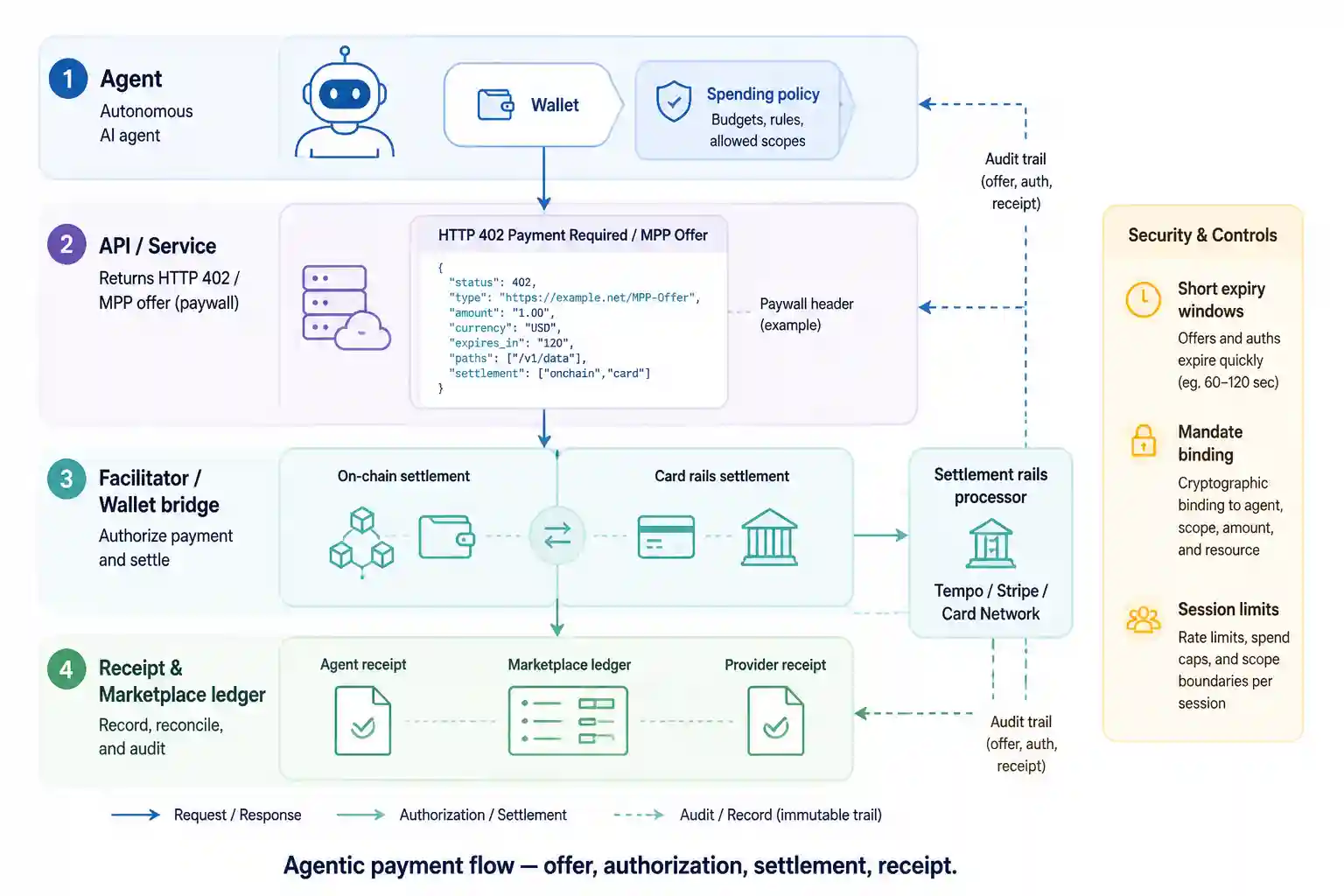
End‑to‑end payment flow (what actually happens at runtime)
A practical, technology‑neutral flow most marketplace operators will recognize:
- Discovery & price negotiation: the agent finds a service and issues a normal API request. If the service is paid, the service returns a 402 Payment Required (or an MPP offer) with explicit price, rail, token/recipient, expiry and optional facilitator URLs. x402 uses JSON envelopes and named headers for this stage. (llmmart.ai)
- Authority and wallet choice: the agent selects a wallet (on‑device wallet, custodial wallet, or a marketplace‑managed credential). The wallet must prove the agent (or its delegating principal) authorized the spend — this can be a signed mandate, a delegated credential, or a passkey/credential bound to a user‑approved policy. Vendor services (e.g., AWS AgentCore Payments) add spending guards such as session limits, credential isolation, and spending governance to reduce abuse risk. (aws.amazon.com.cdn.amazon.com)
- Execute payment: the agent uses the chosen rail
- For x402 flows the agent signs a payment payload and a facilitator posts the settlement on‑chain (commonly using stablecoins on L2s such as Base). The server verifies facilitator settlement before returning the resource. (llmmart.ai)
- For MPP flows the agent may trigger a PaymentIntent‑style flow that routes through Stripe (cards, BNPL, tokens) or Tempo (native payment token) or other supported rails; MPP is explicitly rail‑agnostic and maps to the payment processor’s primitives. (stripe.com)
- Receipts and settlement records: after settlement the service emits a receipt/settlement object tying the transaction to the original request, mandate, and any facilitator transaction IDs. Marketplaces and agents should capture these records for auditing, dispute handling, and reconciliation. x402 and MPP both include fields or primitives to carry settlement receipts back to callers. (llmmart.ai)
Recent, credible developments (what changed and why it matters)
- AWS: Amazon Bedrock AgentCore Payments reached general availability (Aug 18, 2026). AgentCore Payments bundles wallet provisioning (Quick Create with Coinbase), a curated MCP/x402 catalogue, MPP support, and guardrails (session/spending limits, observability). The AWS announcement demonstrates a major cloud provider treating agentic payments as a managed production capability rather than an experiment. (aws.amazon.com)
- Stripe & Tempo: the Machine Payments Protocol (MPP) launched with Tempo mainnet earlier in 2026 and is positioned as a rail‑agnostic standard for agents. Stripe’s developer guidance maps MPP to existing payment primitives (PaymentIntents) to lower integration friction for merchants who want to accept machine payments. MPP is explicitly intended to support hybrid settlement: stablecoins, cards, and other rails. (stripe.com)
- x402 ecosystem and reference implementations: x402 (an HTTP 402 based paywall) has active reference code, facilitator implementations, and SDKs. It is already used in pay‑per‑call API deployments and favored where stablecoin settlement and minimal integration latency matter. (mpp.best)
- Card‑rails pilot (Visa + Revolut): on Sept 7, 2026 Visa and Revolut completed a controlled pilot in France where an AI agent initiated a real transaction authenticated with Visa Payment Passkey; issuer authorization and tokenization remained with the bank. This is a concrete demonstration that existing card rails and modern authentication (passkeys) can support agent‑initiated payments under issuer control. For API marketplaces, that reduces the theoretical binary choice between ‘on‑chain’ and ‘cards’ — hybrid paths are viable. (visa.fr)
- Security and formal analysis: multiple academic and vendor analyses released in 2026 have formalized agent payment protocols (x402, MPP, AP2) and exposed attack classes — notably replay, mandate misuse, and context‑binding failures. These analyses argue for explicit design choices: short expiry windows, explicit context binding between checkout and payment, mandatory receipts, and strong spending policies. (arxiv.org)
Practical controls marketplaces and operators should implement
- Separate concerns: discovery & price negotiation (marketplace catalog) should be distinct from payment execution (wallet/rail). Capture the 402/MPP offer and persist it as a verifiable object. (llmmart.ai)
- Enforce spending policy: session limits, per‑agent and per‑principal caps, whitelists, and hard stop conditions are essential. Vendor stacks (for example AWS AgentCore Payments) already include spending governance primitives. (aws.amazon.com.cdn.amazon.com)
- Make receipts first‑class: return structured settlement objects that include facilitator tx IDs, mandate IDs, and original request IDs for reconciliation and dispute handling. (llmmart.ai)
- Support hybrid rails: implement adapters for x402/facilitators (stablecoin onchain settlement) and MPP/card rails, and design reconciliation processes that map on‑chain facilitates to fiat settlement windows. (mpp.best)
- Harden against protocol attacks: require context binding (link checkout → mandate → payment), short expiry windows, and monotonic sequence numbers for authorizations; monitor for unusual agent loops or repeated microtransactions. Formal analyses recommend these mitigations. (arxiv.org)
Bottom line for M2M Market (and similar API marketplaces)
The near‑term reality is hybrid: card rails (with passkeys and tokenization), machine rails (MPP), and HTTP 402/x402 stablecoin flows will coexist. Marketplaces that provide discovery, controlled provider consumption, and settlement should design their payment integration layer to:
- Capture and persist the paywall/offer object returned by the provider;
- Orchestrate wallet selection and enforce marketplace spending policies before allowing an agent to approve a payment; and
- Persist an auditable receipt and facilitator/settlement identifiers for reconciliation.
These are implementation decisions that sit above any particular rail or protocol; they let a marketplace safely support whichever rail a provider or customer prefers while maintaining control over discovery, consumption, and settlement. (aws.amazon.com.cdn.amazon.com)
Sources and further reading
Primary vendor and protocol documents cited above include AWS Bedrock AgentCore Payments announcements and docs (AgentCore Payments GA and technical deep dives), the Stripe Machine Payments Protocol announcement and Sessions coverage, the x402 protocol docs and reference repos, the Visa press release on the Revolut pilot, and recent formal security analyses of agent payment protocols. For specifics and implementation links see the in‑text citations above. (aws.amazon.com.cdn.amazon.com)