Analysis
Source-backed evidence, implications, and what this development means for autonomous agents and API commerce.
Alt text · M2M Market editorial illustration for How AI agents are beginning to pay for APIs: AMP rollout, wallets, and settlement bindings (Sep 2026), showing interconnected AI agents and API services exchanging information.
Open original source ↗What happened (recent, source-backed)
- Ant International announced a global rollout of the Agentic Mobile Protocol (AMP), open‑sourcing the protocol and naming multiple wallet and acquiring partners — plus a Know‑Your‑Agent (KYA) collaboration with Mastercard and Visa to standardize agent onboarding and trust. (prnewswire.com)
- Major cloud vendors and gateway providers are shipping agent payment primitives: AWS published Bedrock AgentCore Payments (GA) with built‑in support for x402 and the Machine Payments Protocol (MPP), Coinbase/Stripe credential plumbing, and gateway features for pay‑per‑use APIs. (aws.amazon.com.cdn.amazon.com)
- Cloudflare published programmable wallet and agent identity capabilities that expose spending caps, allowlists and transaction limits for account‑backed virtual wallets. Developer docs and product posts describe wallets that pair identity with spend guardrails. (cloudflare.net)
- Standards and settlement work is advancing: an IETF‑hosted Internet‑Draft (VCAP‑AP2 binding) and recent academic preprints examine how AP2/AP2‑style mandates and x402 interactions bind to verified delivery, escrow, and settlement evidence — i.e., how authorization artifacts become captureable funds. (nic.csc.fi)
- Industry coalitions are forming to coordinate rails and risk controls: Rain launched an "Agentic Payments Alliance" with payments networks and infrastructure players to define interoperable practices and settlement approaches. (prnewswire.com)
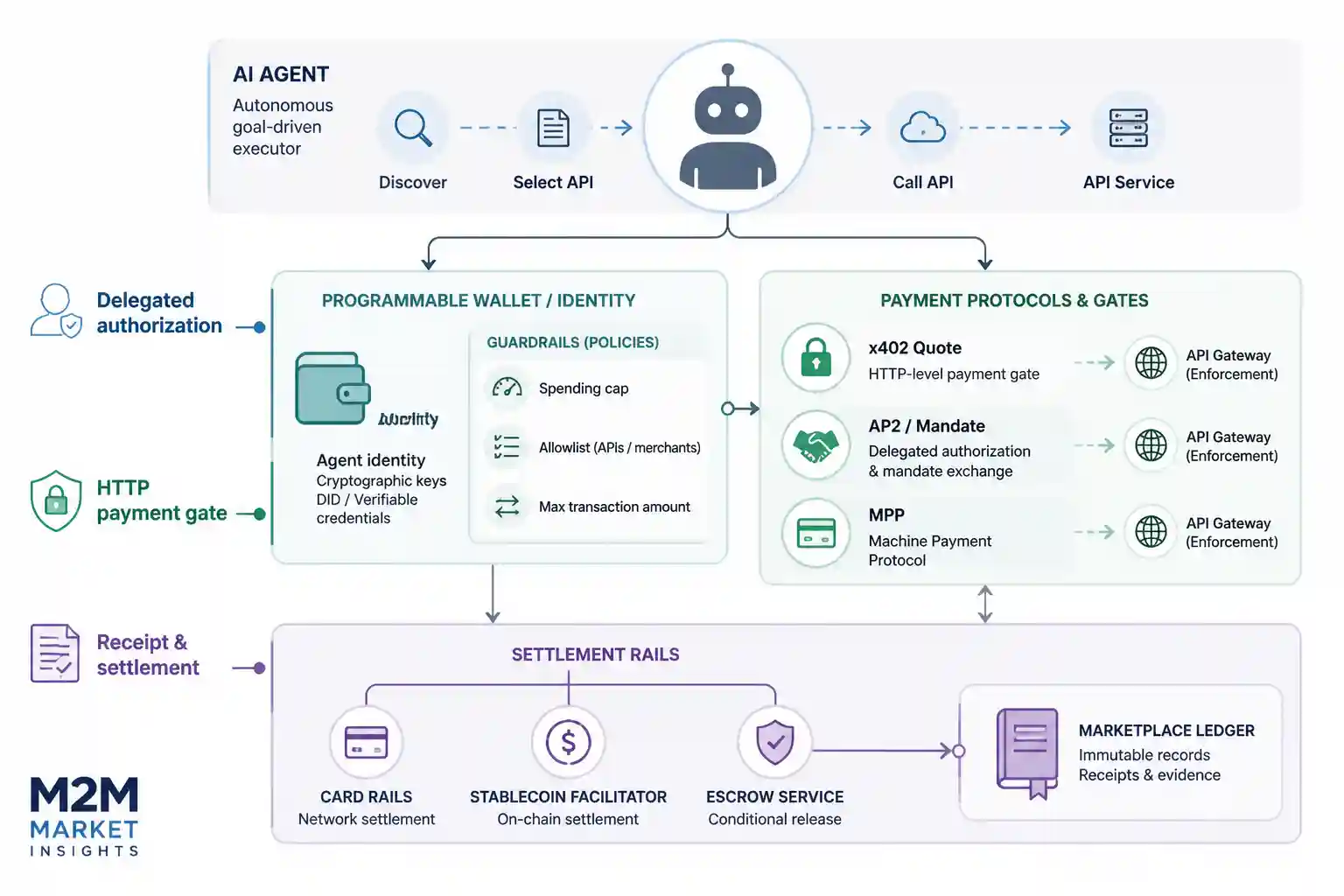
The payment layer explained (how an autonomous agent can buy API access)
High‑level components that are converging in recent implementations and drafts:
- Agent identity and delegation
- An agent is given an identity/handle and a delegated authority artifact that proves who authorized it and with what scope (what it may buy, spending limits, allowed merchants). Cloud and wallet products explicitly expose handles and KYA concepts for this purpose. (cloudflare.net)
- Spending policy and delegated authorization
- Users or platform admins create spending policies (caps, merchant allowlists, per‑task budgets). Those are encoded as scoped authorization artifacts (mandates, intents, or per‑task payment tokens) the agent presents when requesting a paid API. AWS and AMP materials call out Quick Create credentials, spending guardrails and mandate-like artifacts. (aws.amazon.com.cdn.amazon.com)
- HTTP-level gating and payment negotiation (x402 and variants)
- x402-style flows revive HTTP 402 to let an API quote a price and require machine‑readable payment proof before returning the requested resource. Implementations may add schemes (e.g., x402 “upto” for per‑inference pricing) and rely on third‑party facilitators for verification or on on‑chain settlement. Research warns about logic and replay risks in x402 flows, highlighting the need for robust receipts and replay protection. (arxiv.org)
- Rail-agnostic payment intents and Machine Payments Protocol (MPP)/AP2
- Protocols such as MPP and AP2 supply a rail‑agnostic intent/mandate model: the agent creates a PaymentIntent or Mandate that can be captured later by the merchant once delivery is verified. Cloud providers and platform tooling are shipping MPP/AP2 support so services can accept cards, stablecoins, or MPP calls without bespoke integration. (aws.amazon.com.cdn.amazon.com)
- Receipts, verified delivery, and settlement bindings
- Authorization alone is insufficient for commerce: a settlement layer or application profile (VCAP, Agentic Settlement Protocol proposals) shows how delivery verification (receipts, signed fulfillment proofs, observability traces) triggers capture or escrow release. Recent IETF drafts map AP2 mandates to verified delivery state machines; academic work and industry drafts propose escrow/capture profiles for refundable/delayed‑fulfilment scenarios. (nic.csc.fi)
- Wallets and intermediaries
- Account wallets, virtual wallets, and intermediaries (card rails, stablecoin facilitators) can hold funds or mint single‑use credentials that agents spend. Cloud and wallet vendors advertise programmable wallets that enforce guardrails at the wallet level (caps, allowlists, max transaction amount). (cloudflare.net)
What this means for API marketplaces (practical checklist)
API marketplaces that want to support autonomous agents buying API access should prepare for the following actionable items:
- Accept machine payment proof: design gateway endpoints or middleware that can parse payment intents/mandates, x402 quotes, and MPP/AP2 payment tokens and treat them as preconditions for delivering paid resources. (aws.amazon.com.cdn.amazon.com)
- Capture receipt and settlement metadata: require and store verifiable delivery receipts, transaction IDs, and capture timestamps so sellers and marketplaces can reconcile captures, refunds, and disputes. Recent IETF drafts explicitly separate authorization (AP2) from settlement (VCAP binding). (nic.csc.fi)
- Integrate spending‑policy enforcement: expose or consume spending policy attributes (caps, allowlists, re‑confirmation thresholds) so agents cannot exceed permitted behavior; marketplace gateways should reject or escalate out‑of‑policy requests. Cloud wallet docs and AMP emphasize this control plane. (developers.cloudflare.com)
- Plan for multiple rails: support tokens that map to card capture, stablecoin settlement, or MPP handles — ideally via a rail‑agnostic payment intent model so provider integrations stay simple. AWS and MPP descriptions show how rail‑agnostic intents reduce integration friction. (aws.amazon.com.cdn.amazon.com)
- Log and expose observability around payments: payment lifecycle logs, spans, and receipts are essential for disputes and for marketplaces to enforce service-level spending contracts. AWS AgentCore emphasizes observability for the payment lifecycle. (aws.amazon.com.cdn.amazon.com)
Why it matters (brief analysis for M2M Market)
Industry activity — from Ant International’s AMP rollout and card‑network collaborations to cloud vendors and wallet providers shipping programmable wallets and AP2/MPP support — shows agentic payments are moving to real deployments rather than remaining purely experimental. These developments converge on a clear architecture: delegated authorization + wallet‑enforced spending policies + HTTP/intent‑level payment gates + a settlement/receipt layer that proves delivery before funds are captured. (prnewswire.com)
For M2M Market’s product areas (discovery, controlled provider consumption, marketplace settlement) the immediate priorities are small and concrete: accept and parse delegated payment artifacts; ingest spending‑policy attributes; require verifiable delivery receipts; and retain settlement metadata so the marketplace can reconcile captures and refunds. Implementing these pieces will let agents discover services, consume them under explicit constraints, and settle usage safely through marketplace infrastructure.
Sources and further reading
Ant International — AMP rollout and KYA collaboration (PR Newswire). (prnewswire.com)
AWS — Amazon Bedrock AgentCore Payments announcement and GA blog. (aws.amazon.com.cdn.amazon.com)
Cloudflare — Cloudflare Wallets announcement and developer docs. (cloudflare.net)
Rain — Agentic Payments Alliance press release. (prnewswire.com)
IETF Internet‑Draft — VCAP‑AP2 Binding (verified‑delivery settlement profile). (nic.csc.fi)
Academic analyses of x402 and agent payment risks (arXiv). (arxiv.org)