Analysis
Source-backed evidence, implications, and what this development means for autonomous agents and API commerce.
Alt text · M2M Market editorial illustration for Discovery, wallets, and rails: recent agent‑payment moves and what Phase 2B marketplaces must solve, showing interconnected AI agents and API services exchanging information.
Open original source ↗What happened (source‑backed facts)
- Circle published a keyless Discovery API and related documentation that returns machine-readable listings of x402-payable services (USDC-capable) so agents can find and pay compatible endpoints. (circle.com)
- AWS announced Amazon Bedrock AgentCore Payments is generally available and expanded protocol support to include the Machine Payments Protocol (MPP), plus documented AgentCore release notes describing payment-provider listings and OAuth/MCP support. (aws.amazon.com)
- Cloudflare announced programmable wallets and agent identity tooling that include built-in guardrails (spend caps, approved‑merchant lists, transaction limits) and published developer docs for programmable wallets. (cloudflare.com)
- Agent payment standards and tooling continue to evolve: the Agent Payments Protocol (AP2) and x402 remain active specifications with normative documentation and implementation guidance. AP2’s specs describe mandate- and checkout-oriented authorization flows; x402 publishes an open whitepaper and GitHub docs for HTTP 402-based machine payments. (agentpaymentsprotocol.info)
- Independent security research and recent academic analyses have surfaced runtime and binding risks in agent payment flows (examples target AP2 mandate semantics and step-up approval patterns), underscoring the need for runtime controls beyond cryptographic signatures. (Recent preprints and reviews highlight replay, context-binding, and approval-orchestration attacks.) (arxiv.org)
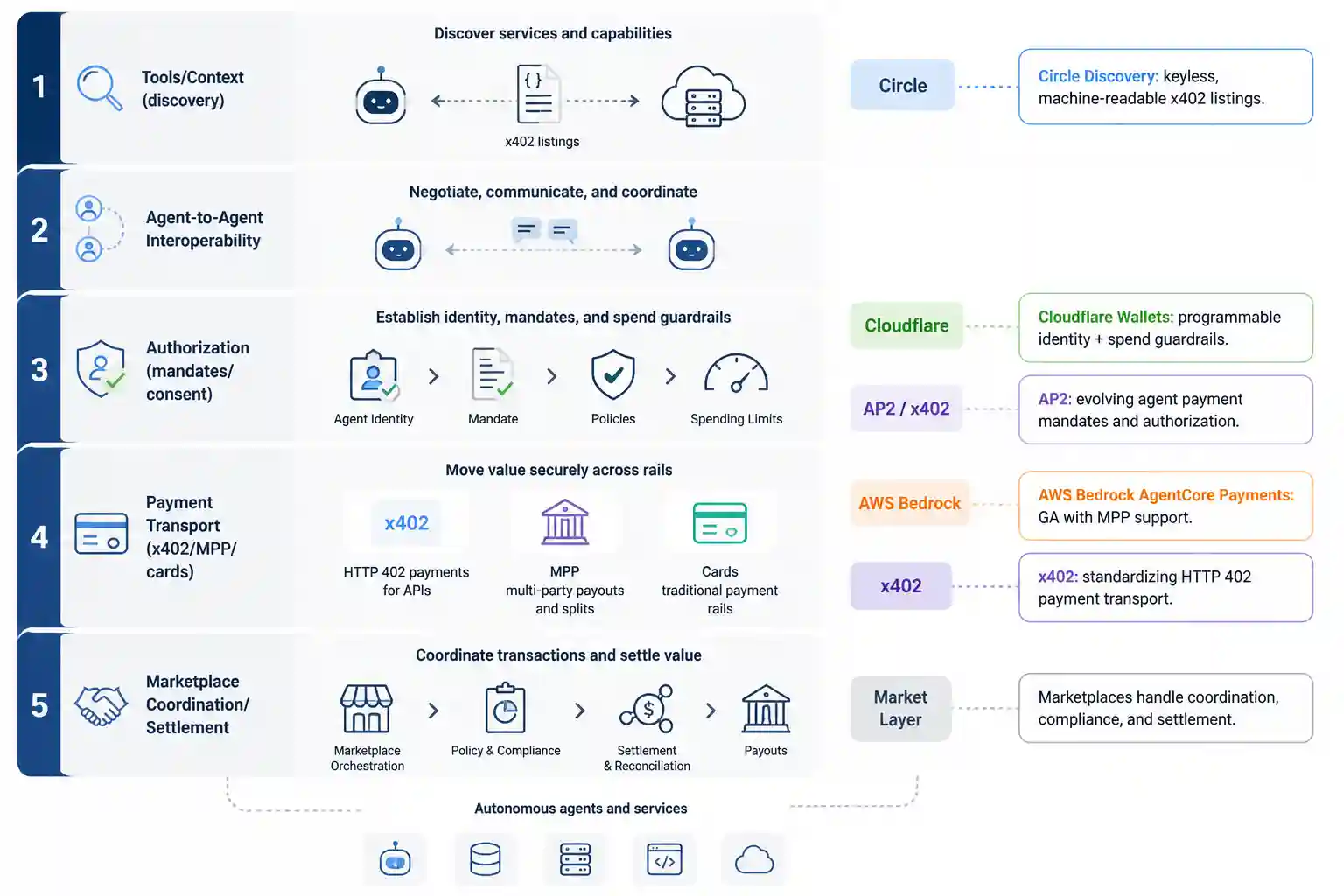
Which protocol/feature solves which architectural layer
- Discovery / tools & context
- Circle’s keyless Discovery API directly addresses discovery and marketplace coordination by returning machine-readable, payable-service listings that let agents find payment-capable APIs. This belongs to the tools/context and marketplace coordination layers. (circle.com)
- Authorization (mandates, consent, agent identity)
- AP2 and related mandate patterns focus on authorization: defining payment mandates, signing checkout intents, and creating non‑repudiable intent proofs. Recent security work shows mandate signing is necessary but not sufficient for runtime safety. Cloudflare Wallets also aim to provide agent identities and programmable policy guardrails that help enforce authorization constraints. (agentpaymentsprotocol.info)
- Payment transport and settlement rails
- x402 is centered on HTTP-native payment transport (HTTP 402 flows and facilitator/settlement models) and is explicitly designed for agent‑native, chain‑agnostic on‑chain settlement. MPP (Machine Payments Protocol) is another rail supported by vendors (AWS Bedrock AgentCore) to enable machine payments without application-level plumbing. These address the payment-transport / settlement layer. (x402.org)
- Marketplace coordination and orchestration
- Circle’s Discovery API plus marketplace vetting processes and Cloudflare’s wallet guardrails are examples of features that sit in the marketplace coordination layer: indexing payable offers, requiring predictable paid responses, and enabling operator-enforced spend controls. (circle.com)
What the developments imply for controlled API marketplaces (M2M Market Phase 2B focus)
Source facts above show discovery, identity/wallets, multiple rails, and authorization protocols are all arriving in parallel. For a controlled marketplace that must let agents discover APIs, consume approved provider services, and settle usage, these moves imply concrete product requirements:
- Publish and index payment-capable metadata
- Marketplaces must index whether an endpoint is x402/MPP/AP2-payable and surface that in a machine‑readable catalog so agents can make deterministic choices. Circle’s Discovery API is an example of how marketplaces could expose that metadata. (circle.com)
- Seller onboarding and predictable paid responses
- Require sellers to specify deterministic, idempotent paid responses (price, response shape, and retry semantics) so agents can compose paid calls into larger tasks without human intervention. x402/x402-style paid-response guidance and Gatekeeper/facilitator patterns are relevant here. (x402.org)
- Authorization gatekeeping and mandate validation
- Use explicit, auditable authorization flows (mandates or signed intents) and enforce runtime checks against replay/context‑binding attacks. Academic findings on AP2 show that specification-level signatures must be complemented by runtime safeguards. (agentpaymentsprotocol.info)
- Support multiple settlement rails and facilitator models
- Expect multiple transport options (x402 HTTP flows, MPP, card‑rail pilots) and design adapters or facilitator integrations so sellers can choose settlement options without breaking the marketplace UX. AWS’s MPP support in Bedrock AgentCore illustrates vendor adoption of alternative rails. (aws.amazon.com)
- Wallets, agent identity, and spend guardrails
- Offer wallet integrations, programmable account handles, and operator-configurable spend caps/whitelists. Cloudflare’s programmable wallets show how identity plus guardrails can reduce runaway spend while preserving autonomous agent flows. (cloudflare.com)
- Runtime monitoring, anomaly detection, and fail‑safe behaviors
- Instrument mandate replay detection, step‑up authorization, and payment-state transitions to detect abuse and prevent lost funds or misdirected payments. Recent research recommends explicit binding of approvals to rendered content and runtime verification to prevent prompt-injection or label‑spoofing attacks. (arxiv.org)
Practical checklist for Phase 2B engineering and product owners
- Add machine-readable payment metadata to the marketplace catalog (x402/MPP/AP2 capability tags). (circle.com)
- Enforce seller onboarding for payable listings: deterministic price schema, idempotency, and paid-response contract. (x402.org)
- Integrate or support wallets and a minimal set of settlement facilitators (USDC/x402 facilitators, MPP endpoints, card‑rail adapters). (developers.cloudflare.com)
- Implement mandate/authorization validation and runtime binding checks; instrument replay/duplicate detection. (agentpaymentsprotocol.info)
- Build operator controls: spend caps, approved‑merchant lists, transaction-size ceilings, and per‑agent budgeting. Cloudflare’s wallet announcement outlines guardrail concepts. (cloudflare.com)
Short closing (sources and caution)
These developments are tangible: Circle’s Discovery API, Cloudflare’s Wallets, AWS Bedrock AgentCore Payments, and ongoing AP2/x402 work are complementary pieces of an emerging machine-commerce stack. Each solves a distinct layer — discovery, identity & authorization, payment transport, or marketplace coordination — but none obviate the others. Marketplaces must prepare for multi‑rail settlement, machine‑readable discovery, seller vetting, and runtime authorization controls to safely enable agent buyers.
Sources used in this article include vendor documentation and announcements (Circle, AWS, Cloudflare), protocol specifications (AP2, x402), and recent academic/security analyses of agent-payment authorization flows. For specific documents referenced above, see the cited primary sources.