Analysis
Source-backed evidence, implications, and what this development means for autonomous agents and API commerce.
Alt text · M2M Market editorial illustration for Discovery + Payments: Recent AP2/x402/MPP moves and which protocol layers they actually solve, showing interconnected AI agents and API services exchanging information.
Open original source ↗Executive summary
Several recent, source-backed developments materially advance how autonomous agents will find paid services and complete payments. Circle published a keyless Discovery API that returns x402-compatible, USDC-payable service listings, enabling programmatic discovery of payable endpoints. (circle.com)
AWS announced Amazon Bedrock AgentCore Payments as generally available and documents explicit support for x402 (including an `upto` scheme) and the Machine Payments Protocol (MPP), bringing both HTTP-402 payment dialects into a production-grade agent runtime. (aws.amazon.com.cdn.amazon.com)
Cloudflare announced programmable Account Wallets + Virtual Wallets and stable agent handles to bind identity and spending guardrails to agents. Those features are intended to make agent identity and delegated spending practical for web-scale agent interactions. (cloudflare.com)
Separately, standards and research work continue: MPP has published improvements (session-based metering) and reference implementations, and independent security analyses of AP2 (Agent Payments Protocol) have begun to surface risks around context‑binding and replay that marketplaces must consider. (mpp.dev)
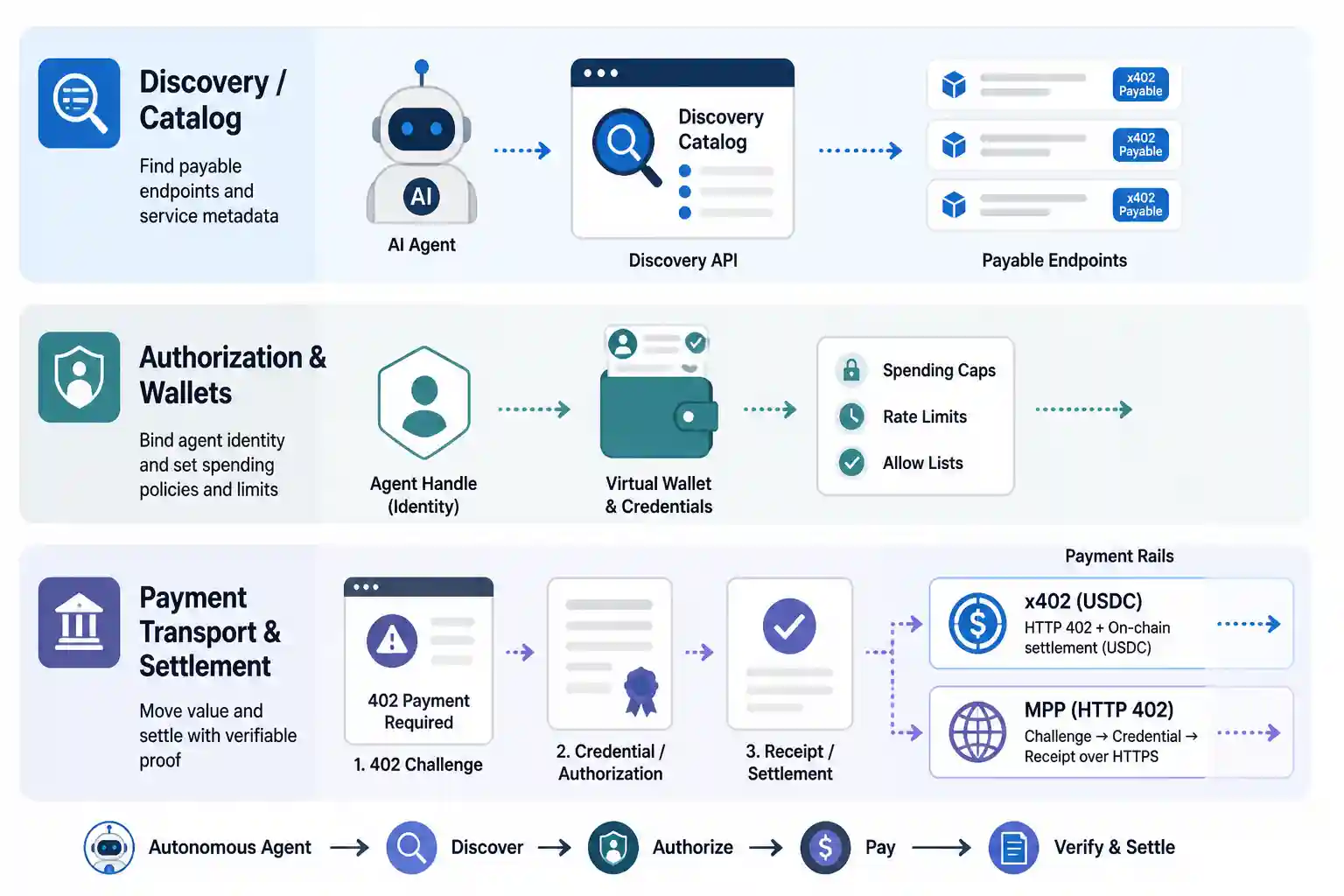
Which architectural layer each development addresses
- Marketplace coordination / discovery
- Circle’s keyless Discovery API (x402 discovery) directly targets marketplace coordination: it provides a single, public endpoint agents can query to find payable services, read accepted payment methods, amounts, and pay-to addresses before attempting a transaction. This removes manual onboarding friction for agents and shifts part of marketplace work into machine-readable catalogs. (circle.com)
- Payment transport and settlement
- AWS Bedrock AgentCore Payments GA added support for x402 `exact` and `upto` modes and for MPP, meaning the runtime can parse 402 Payment challenges, present credentials, and handle receipt/settlement workflows. Those features operate at the payment-transport and settlement layer — they are the runtime plumbing that converts an agent’s decision to pay into an authenticated HTTP-402 handshake and a verifiable settlement artifact. (aws.amazon.com.cdn.amazon.com)
- MPP’s session and multi-method discovery improvements are explicitly about payment transport efficiency and extensibility (sessions let agents authorize incremental spend so high-throughput metered APIs can bill at fine granularity). These are payment-transport optimizations and discovery extensions that reduce per-request friction. (mpp.dev)
- Authorization / identity
- Cloudflare Wallets and agent handles address the authorization/identity layer: stable agent identifiers plus Account/Virtual Wallets let marketplaces and providers verify “who” authorized a purchase and enforce guardrails such as spend caps or allowlists before allowing a paid action. This is an authorization posture that complements protocol-level payment challenges. (cloudflare.com)
- Protocol-level risk and verification
- Independent security analyses of AP2 and related mandate-based schemes have begun to document high‑risk failure modes such as poor context binding, replay opportunities, and ambiguity in what a signed mandate actually authorizes. Those findings map to the authorization/trust and settlement-audit layers: marketplaces must log and retain the artefacts needed for dispute resolution and fraud investigation. (arxiv.org)
What this means for API marketplaces (practical actions)
M2M Market’s product focus (API-service discovery, controlled provider consumption, and marketplace settlement) aligns naturally with the gaps these vendor and standards moves address. For marketplace operators the following actions are practical and defensible:
- Publish and validate machine-readable listings and payment metadata
- Offer discovery metadata that maps cleanly to x402 / MPP discovery fields (payment methods, amounts/pricing schemes, payTo targets). Use health-checking and sanctions screening as Circle describes for catalog reliability. (circle.com)
- Enforce authorization and guardrails at the marketplace layer
- Require verifiable agent identity and attach enforceable spend policies (allowlists, per-agent caps, session budgets). Plan to accept or verify receipt/settlement proofs from both x402 and MPP-style flows so you can reconcile and audit agent transactions. Cloudflare’s Account/Virtual Wallet model is a concrete example of owner‑delegated guardrails. (cloudflare.com)
- Build settlement adapters and receipt handling
- Implement a settlement adapter that can ingest x402 receipts and MPP credentials/receipts, normalize them into the marketplace’s accounting model, and retain provenance for disputes. AWS AgentCore documentation showing MPP and x402 support illustrates how runtime integrations expose the HTTP 402 lifecycle to a payments manager. (docs.aws.amazon.com)
- Harden for authorization and replay risks
- Treat academic security findings against AP2 and mandate-based flows as operational requirements: bind context to mandates, version and timestamp critical fields, and build replay-resistant verification and audit trails. Document retention and support for dispute resolution will be required in practice. (arxiv.org)
Short checklist for immediate product work (90–120 day horizon)
- Add or map machine-readable payment metadata to your listing schema (network, asset, scheme, payTo). (circle.com)
- Prototype a settlement adapter that accepts x402 receipts and MPP credentials and demonstrates end-to-end reconciliation with provider payouts. (docs.aws.amazon.com)
- Design agent identity and spend policy primitives (virtual-wallet-like allowlists and caps) and a verification endpoint for providers. (cloudflare.com)
- Incorporate signed mandate/context-binding checks into your dispute workflow in response to AP2 security analyses. (arxiv.org)
Closing notes
The recent vendor and standards activity shows the agentic payments stack fragmenting into interoperable pieces: discovery/catalogs, identity/wallets, payment transport (x402, MPP), and protocol security analyses that raise operational requirements. For API marketplaces that control discovery, provider consumption, and settlement, the near-term work is primarily engineering and policy: publish machine-readable payment metadata, enforce per-agent authorization and spend guardrails, and implement settlement adapters that normalize x402 and MPP artifacts into your accounting and dispute workflows. The goal is not to pick a single protocol now, but to expose the marketplace’s interfaces so agents and providers can interoperate safely as protocols converge.