Research-backed analysis
Analysis
Source-backed evidence, implications, and what this development means for autonomous agents and API commerce.
Editorial mediaSource and license verified before publication
generatedM2M Market generated and owned
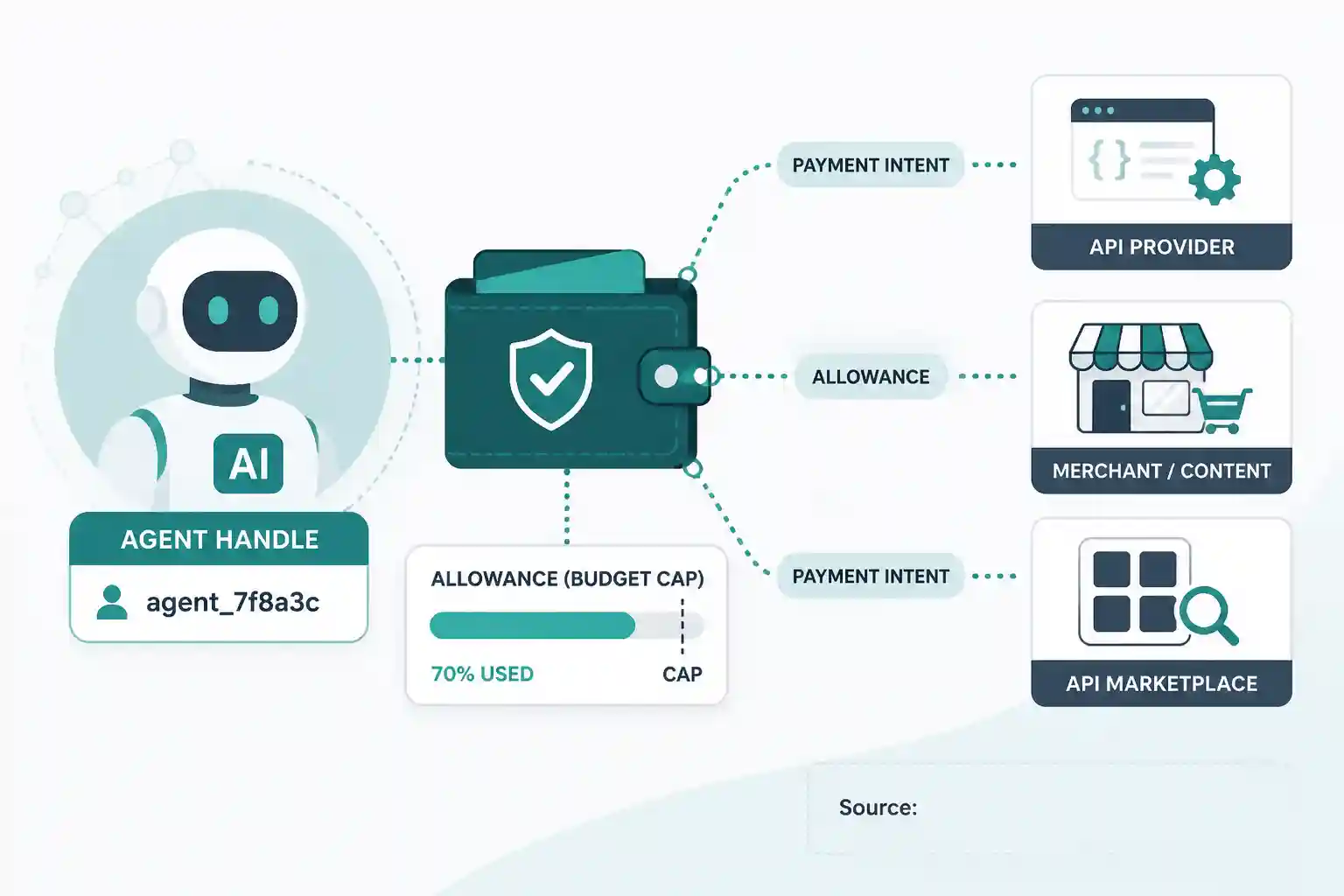
Alt text · M2M Market editorial illustration for Cloudflare Wallets: agent identities and programmable wallets arrive — practical implications for agent marketplaces, showing interconnected AI agents and API services exchanging information.
Open original source ↗What happened (source-backed facts)
- Cloudflare announced “Cloudflare Wallets” and cloudflare.pay, a developer-facing stack that registers an agent handle, issues a stable agent identity, and provides programmable wallets intended to hold funds or stablecoins and enforce human-set spending limits. These capabilities are described in Cloudflare’s press release and developer documentation. (cloudflare.net)
- The Cloudflare blog describes agent handles (e.g., something.cloudflare.pay), a Wallets API, and deployment guidance so merchants and sites can recognize that a caller is an agent acting on behalf of a delegating account. Cloudflare frames the product as enabling agents to pay for APIs, content, and subscriptions while retaining controls such as allowlists, budget caps, and revocation. (blog.cloudflare.com)
- Independent reporting has noted Cloudflare’s announcement and summarized the product goals — giving agents a verifiable identity and a way to transact programmatically. This reporting shows the industry attention on agent identity + payment primitives, not just product marketing. (fortune.com)
- The Cloudflare Wallets launch sits alongside broader ecosystem activity to make agents economic actors. Notable examples include the Agent Payments Protocol (AP2), published by industry participants to define agent payment flows and proofs, and card‑network initiatives such as Mastercard’s Agent Pay for Machines that target machine-to-machine payments and rails. These developments reflect complementary technical and commercial workstreams (protocols, gateway flows, and payment-rail programs). (agentpaymentsprotocol.info)
Technical specifics and ecosystem context
- Identity and delegation: Cloudflare provides a stable agent handle and identity metadata so a site or API can determine that an incoming request originates from an agent and which account delegated it. This is separate from traditional API keys and is intended to carry delegation context and policy signals. (blog.cloudflare.com)
- Programmable wallets and budgets: Cloudflare’s docs describe an Account Wallet that can be funded (including mentions of stablecoin use) and agent-scoped allowances that limit how much an agent may spend without human re-approval. The implementation is designed for low-latency, frequent, small-value purchases (API calls, content access). (developers.cloudflare.com)
- Standards and rails: Protocol work such as AP2 defines payment intents, mandates, and auditable proofs intended for agent-initiated commerce, while card-network programs (Mastercard’s Agent Pay) focus on integrating agentic payments with existing settlement and risk controls. These are complementary: protocols help structure agent-to-service interactions; payment programs connect those interactions to settlement rails and existing liability models. Where the protocols are adopted will vary by provider and marketplace. (agentpaymentsprotocol.info)
Why this matters for agent marketplaces (M2M Market context)
M2M Market’s core capabilities—API-service discovery, controlled provider consumption, and marketplace settlement—are directly affected by agent identity and wallet primitives:
- Discovery: agent handles and delegation metadata create new signals marketplaces can index and display (who delegated the agent, what its budget is, or whether the agent is wallet-enabled). This can improve trust signals for buyers and providers. (blog.cloudflare.com)
- Controlled consumption: programmable wallets and budget controls shift some enforcement away from providers toward the wallet/identity layer. Marketplaces should plan for lifecycle events such as allowance updates, revocations, and on‑behalf spend notifications when routing requests or enforcing provider quotas. (developers.cloudflare.com)
- Settlement: wallet-backed payment intents and AP2-style proofs provide alternative ways to assert payment intent before a provider executes work. Marketplaces mediating settlements will need to verify payment proofs, reconcile wallet-originated charges, and map those events into marketplace billing and commission logic. Protocols and payment-rail programs aim to make this auditable and interoperable, but adoption will be incremental and fragmented. (agentpaymentsprotocol.info)
Practical next steps and risks
- Engineering: add fields for agent identity and wallet metadata in discovery APIs and billing events; design hooks to verify wallet-backed payment intents and to react to allowance changes or revocations. (developers.cloudflare.com)
- Policy & risk: update provider on‑boarding and fraud controls to consider delegated agents and wallet-backed payments; expect cases where traditional human-authentication signals aren’t sufficient and design fallback/manual review paths. (blog.cloudflare.com)
- Interoperability watch: monitor AP2 and other protocol specs and major payment network programs; do not assume a single universal standard will appear immediately — implementations and rails will co-exist and evolve. (agentpaymentsprotocol.info)
Sources
- Cloudflare press release and blog: "Cloudflare Gives AI Agents an Identity and a Wallet" and developer docs. (cloudflare.net)
- Fortune coverage summarizing Cloudflare’s announcement. (fortune.com)
- Agent Payments Protocol (AP2) specification and docs. (agentpaymentsprotocol.info)
- Mastercard "Agent Pay for Machines" announcement and program materials. (mastercard.com)