Analysis
Source-backed evidence, implications, and what this development means for autonomous agents and API commerce.
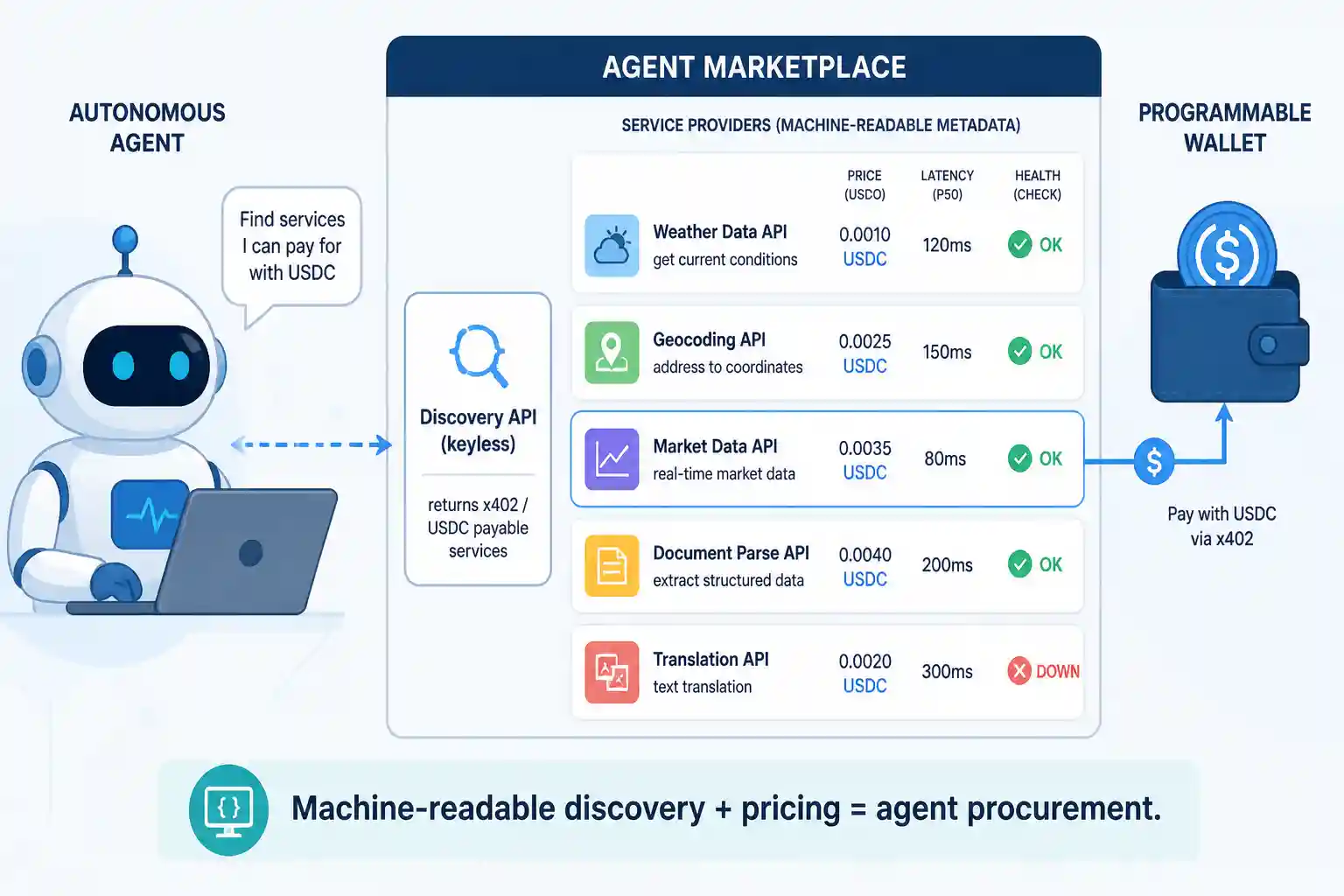
Alt text · M2M Market editorial illustration for Circle’s Discovery API turns service discovery into a machine‑readable market for AI agents, showing interconnected AI agents and API services exchanging information.
Open original source ↗What happened
Circle published a public, keyless Discovery API that returns live, x402‑compatible services which accept USDC and includes searchable metadata, pricing filters, and health checks. Circle describes the endpoint as a single public call agents can use to find payable services without an API key or account. (circle.com)
Independent reporting and developer docs corroborate that this Discovery API is part of Circle’s broader Agent Stack and Agent Marketplace offering (Circle says the marketplace lists hundreds of paid services and that discovery is intended to bootstrap agent buyer flows). (circle.com)
Why this is different from protocol work
Standards such as the Agent Payments Protocol (AP2) or on‑chain request/quote patterns (x402/MPP variants) define how agents and payment rails can authenticate intent, sign mandates, and move value. Those protocols address authorization, non‑repudiation, and settlement message formats. (cloud.google.com)
A marketplace discovery API is a different functional layer: it answers the question “which payable endpoint should an agent call, what will it cost, and how is it reached?” Protocols enable the payment; discovery enables choice and procurement. Circle’s release demonstrates that connectivity+protocol support (the plumbing) is necessary but not sufficient — agents also need a curated, machine‑readable index of providers, prices, and operational signals (health, compliance). (circle.com)
Evidence and corroboration
Circle’s announcement and developer documentation describe the keyless Discovery API, the ability to filter by category/chain/price, and live checks and sanctions‑screening on listed services. (circle.com)
Independent trade coverage and ecosystem reporting confirm the feature and its availability to builders and highlight use cases where agents bootstrap wallets, query services, and then complete payments in USDC. (outposts.io)
Practical implications for API marketplaces and providers
- Machine-readable pricing and capability descriptors matter: marketplaces must standardize the fields an agent uses to compare offers (price per call, rate limits, expected latency, authentication method). Circle’s Discovery API shows this is feasible at scale. (circle.com)
- Health, compliance and onboarding signals become first‑class metadata: Circle advertises live health checks and sanctions screening on listings, which reduces discovery friction for buyer agents. Marketplaces and providers should expose similar machine-readable operational signals. (circle.com)
- Discovery + programmable wallets accelerate procurement: programmable wallets and agent identities (recent vendor wallet announcements) pair with public discovery to create a runnable buyer flow — find → price → authorize → pay — all without manual integration. Providers and marketplaces should map how settlement, refunds, and auditing will work in these flows. (cloudflare.net)
What M2M Market should track and offer (product‑level lens)
- Catalog hygiene: require machine‑readable capability and pricing fields on provider listings so agents can make deterministic provider selections.
- Operational signals: ingest or produce live health and sanctions checks so discovery results are actionable for buyer agents.
- Settlement clarity: surface the settlement rails and any currency/rail constraints as structured fields so agents can select providers they can actually pay and reconcile with settlement. (M2M Market’s marketplace controls for discovery, controlled provider consumption, and settlement are directly relevant here.)
Bottom line
Circle’s Discovery API is a practical market layer that bridges protocol‑level payment primitives and agent buyers by making payable services findable, comparable, and verifiably live. That shift makes the machine‑readable catalogue — pricing, capability descriptors, and operational signals — a near‑term priority for API marketplaces that want to compete as agent customers arrive. (circle.com)