Analysis
Source-backed evidence, implications, and what this development means for autonomous agents and API commerce.
Alt text · M2M Market editorial illustration for AP2, x402, and MPP Move Toward Production: What API Marketplaces Should Prepare For, showing interconnected AI agents and API services exchanging information.
Open original source ↗Executive snapshot
In the last few weeks, several independent developments have materially advanced how autonomous agents will discover, call, and pay for APIs and services:
- Amazon Web Services announced general availability for Amazon Bedrock AgentCore Payments, which includes managed payment capabilities, policy-based guardrails, and support for x402 and the Machine Payments Protocol (MPP). (aws.amazon.com)
- Circle published and documented a keyless Discovery API that lets agents find x402-capable services accepting USDC programmatically, making payable services discoverable without prior onboarding. (circle.com)
- Google’s Agent Payments Protocol (AP2) remains the primary open framework specifying how agents convey authorization (signed “Mandates”), cart contents, and settlement evidence; AP2 also includes an x402 extension for crypto/stablecoin flows. (cloud.google.com)
- Industry coordination is forming: a new Agentic Payments Alliance and multiple payment and infrastructure vendors are publicly convening to address agentic payment rules, custody, and rails. (prnewswire.com)
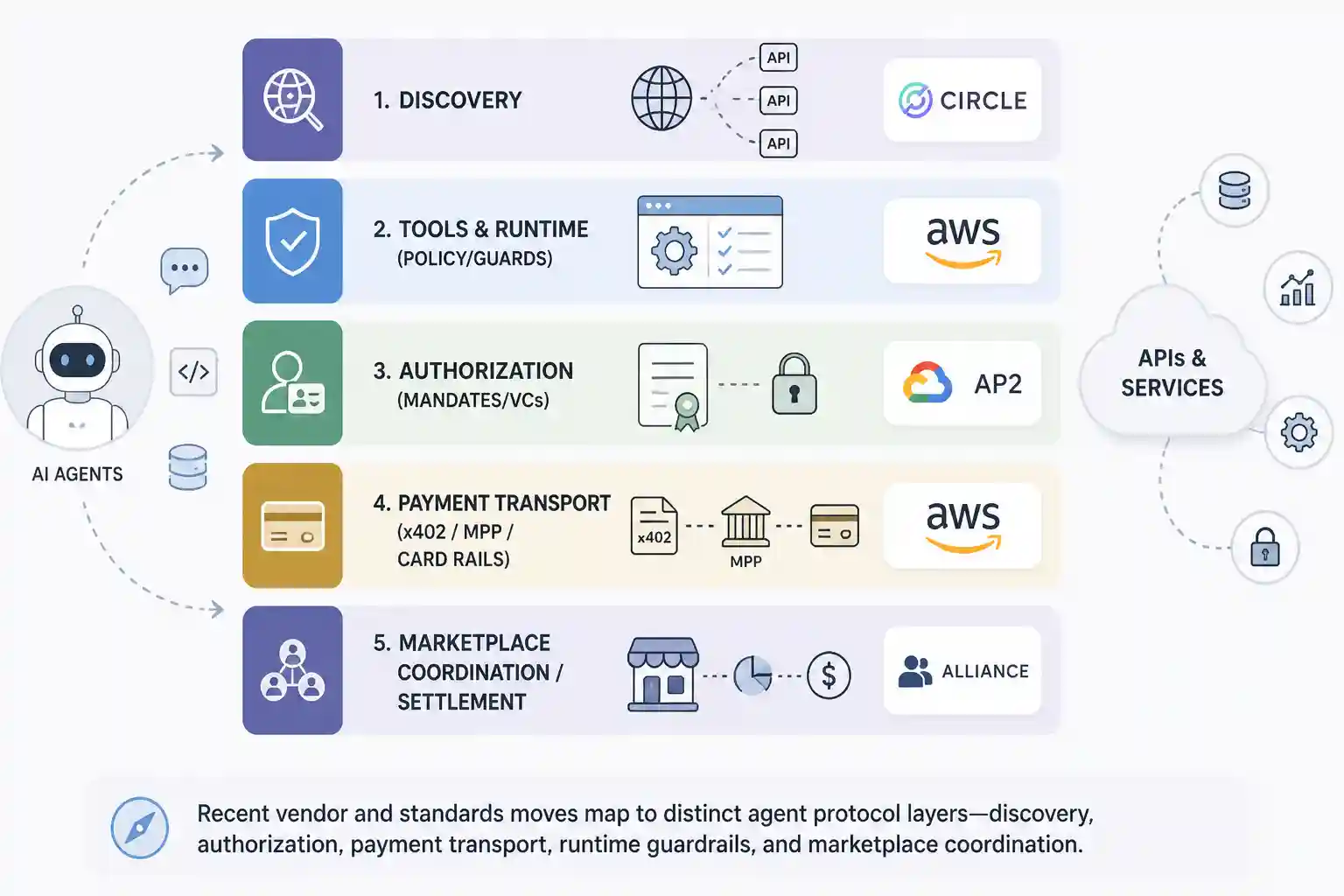
Which architectural layer each development addresses
- Tools / runtime context (policy, guards, observability)
- AWS Bedrock AgentCore Payments delivers managed runtime controls—spending limits, API schema enforcement, and observability—so that payment-capable agents operate within defined guardrails. This is primarily a tools/context and enforcement-layer capability. (aws.amazon.com)
- Payment transport & settlement
- AWS added explicit support for x402 schemes (including a new “upto” variant) and Machine Payments Protocol (MPP), enabling agent-driven transactions to use stablecoin/crypto rails and machine-optimized payment flows. These are implementations on the payment-transport and settlement layer. (docs.aws.amazon.com)
- Circle’s Discovery API is explicitly focused on identifying services that accept USDC and x402-compatible settlement, reducing discovery friction for agents that intend to pay on-chain. This couples discovery with payment-rail eligibility. (circle.com)
- Authorization / intent proof
- AP2 formalizes Mandates (cryptographically-signed intent and cart proofs) and verifiable credentials to prove a user authorized an agent to transact—this addresses the authorization and auditability layer that marketplaces and merchants require. AP2’s design separates intent→cart→payment as an auditable chain. (cloud.google.com)
- Agent-to-agent / agent-to-service interoperability
- AP2 is designed to extend Agent2Agent (A2A) and Model Context Protocol (MCP) concepts into payments; x402 and the AP2 extensions are intended to make payments interoperable across agent ecosystems, reducing bespoke integrations between agents and merchants. (cloud.google.com)
- Marketplace coordination and standards
- The formation of industry coalitions and alliances (publicized vendor lists and the Rain Agentic Payments Alliance) highlights a marketplace/coordination layer where rules, compliance, and settlement models are being debated and aligned. Standards work, vendor SDKs, and marketplace listings will intersect here. (prnewswire.com)
Why this matters for API marketplaces (practical implications for M2M Market)
Source-backed moves toward production-grade payment rails plus discovery change three practical requirements for API marketplaces that enable agent consumption, provider control, and settlement:
- Machine-readable, payment-aware listings. If agents can query a discovery endpoint (for example, Circle’s Discovery API) to find x402/USDC-capable services, marketplaces should publish clear, machine-readable metadata about accepted payment rails and pricing models. This reduces failed purchases and automates eligibility checks. (circle.com)
- Authorization evidence and guardrail enforcement. AP2’s Mandate model demonstrates that marketplaces will be asked to carry or verify auditable intent/cart proofs and enforce spending policies at the gateway. Marketplaces should plan to surface mandate acceptance requirements and provide tooling to validate authorization evidence at call time. (cloud.google.com)
- Wallet and settlement integration options. With wallet products and programmable accounts (for example, Cloudflare Wallets and provider integrations) and with stablecoin rails being used in experiments and production, marketplaces must map which settlement rails they accept, how receipts and settlement proofs are recorded, and how refunds/chargebacks are handled across rails. (cloudflare.net)
Practical next steps for marketplace operators
- Audit service listings for machine-readable pricing and rail metadata; add explicit fields for supported payment schemes (card, x402, MPP, stablecoin). (circle.com)
- Plan for mandate validation: design or integrate an evidence store and validation step so API calls requiring payment include verifiable intent/cart proof before service execution. (cloud.google.com)
- Design settlement reconciliation paths for non-card rails (stablecoins, settlement proofs) and define escrow/timeout behaviors for delegated agent purchases. (docs.aws.amazon.com)
- Track standards and coalitions (AP2, x402 extensions, MPP, industry alliances) and prefer primary-spec/owner documentation for integration choices. (cloud.google.com)
Evidence & sources (selected primary references)
- Google Cloud — Powering AI commerce with the new Agent Payments Protocol (AP2) (protocol design, Mandates, x402 extension). (cloud.google.com)
- AWS — Amazon Bedrock AgentCore Payments GA announcement and release notes (GA features, x402/MPP support, provider integrations, runtime guardrails). (aws.amazon.com)
- Circle — Discovery API and Agent Stack blog posts describing a keyless discovery endpoint for x402/USDC services. (circle.com)
- Cloudflare — Cloudflare Wallets and cloudflare.pay announcement and developer docs describing programmable agent wallets and identity controls. (cloudflare.net)
- PR Newswire / Rain — Agentic Payments Alliance announcement, listing coalition participants and coordination intent. (prnewswire.com)
Closing (editorial note)
These source-backed developments collectively signal that multiple protocol layers are maturing simultaneously: discovery, payment transport, authorization, and runtime enforcement. For API marketplaces enabling agent consumption, the practical work is less about choosing a single “winner” protocol and more about preparing mechanical and operational plumbing: machine-readable listings, mandate validation, wallet/rail compatibility, and settlement reconciliation. Marketplaces that plan for those layers can reduce integration friction as agentic payments move from experimental pilots into production flows.