Research-backed analysis
Analysis
Source-backed evidence, implications, and what this development means for autonomous agents and API commerce.
Editorial mediaSource and license verified before publication
generatedM2M Market generated and owned
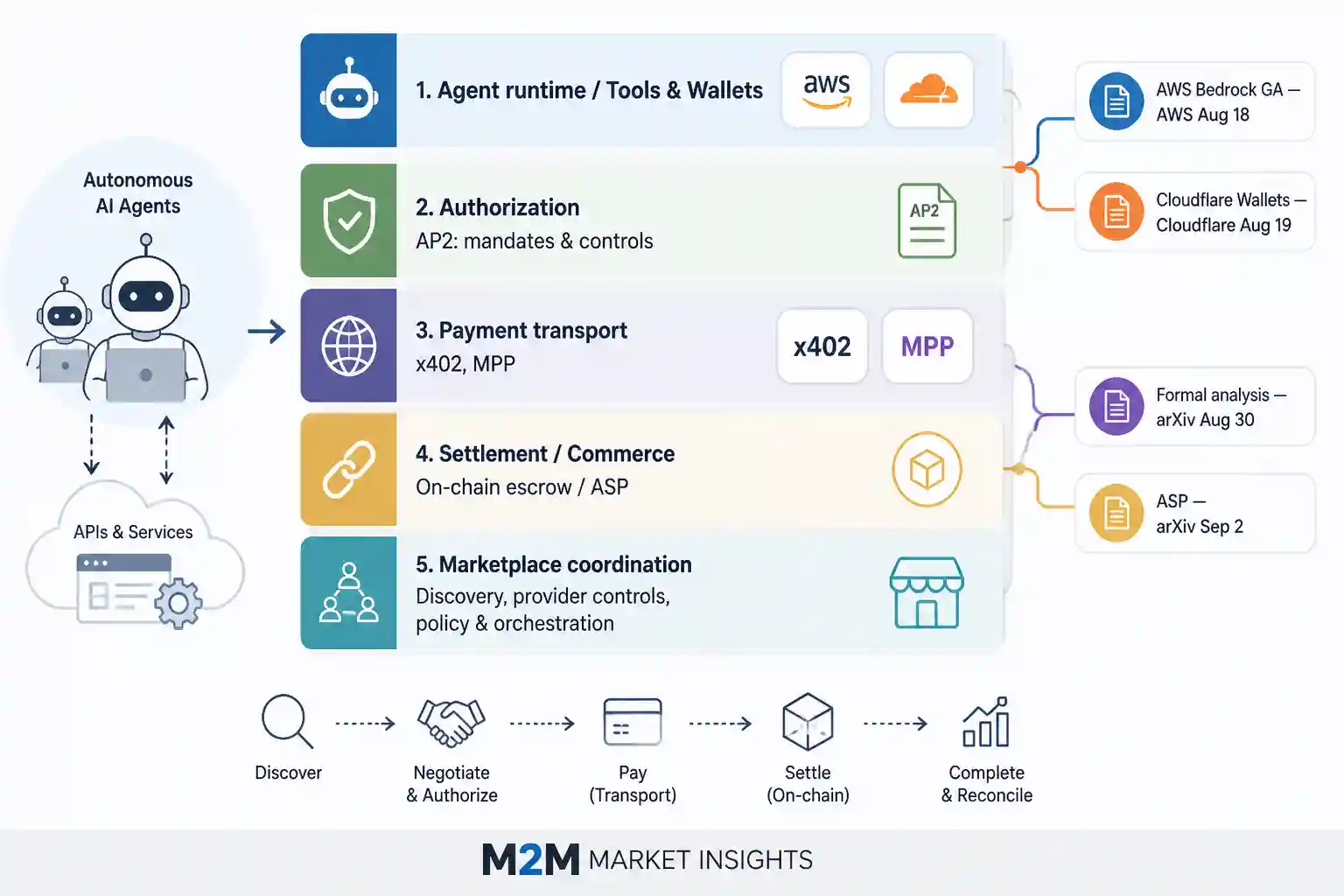
Alt text · M2M Market editorial illustration for Agentic settlement and protocol analysis: new academic and vendor moves that clarify payment, authorization, and settlement layers for agent marketplaces, showing interconnected AI agents and API services exchanging information.
Open original source ↗What happened — current, source‑backed developments
- An academic preprint published Sep 2, 2026, proposes the Agentic Settlement Protocol (ASP), an application profile that layers an on‑chain authorize‑and‑capture escrow model over existing commerce payment rails to support refundable and delayed‑fulfilment agent commerce. The authors position ASP as an application profile that composes on‑chain escrow patterns (CPP/x402r) with off‑chain fulfilment engines. (arxiv.org)
- A formal analysis paper (Aug 30, 2026) models four representative agent payment protocols — x402, MPP, ACP, and AP2 — in a symbolic verification framework, documenting each protocol’s roles, trust assumptions, and lifecycle transitions. That analysis highlights where guarantees are implicit and where implementations must add runtime enforcement. (arxiv.org)
- In parallel, cloud vendors continue production moves: Amazon Bedrock AgentCore Payments reached general availability and advertises protocol‑agnostic payments for agents, expanding GA support to include the Machine Payment Protocol (MPP) and keeping x402 compatibility from preview. Cloudflare has published Wallets documentation describing programmable wallets and stablecoin support for agent identities and payments. These are practical vendor advances that reduce developer friction in paying for paid APIs and services. (aws.amazon.com)
Which architectural layer(s) each development addresses
- Agentic Settlement Protocol (ASP) — Payment transport / Commerce (settlement): ASP explicitly targets settlement: an on‑chain authorize‑and‑capture escrow profile designed for refundable or delayed‑fulfilment commerce where off‑chain confirmation of fulfilment occurs. This is a settlement-layer application profile that sits below marketplace orchestration and above ledger/payment-rail mechanics. (arxiv.org)
- Formal analysis (x402, MPP, ACP, AP2) — Authorization and Payment‑transport (security and lifecycle): The formal models focus on mandates, checkout semantics, and lifecycle transitions (authorize, capture, refund). That work clarifies where protocols depend on runtime enforcement and which properties (e.g., non‑repudiation, context binding) must be satisfied by implementers. This primarily informs the authorization layer and payment‑transport security assumptions. (arxiv.org)
- AWS Bedrock AgentCore Payments (GA) — Tools/context and Payment transport abstraction: AWS’s GA release emphasizes a protocol‑agnostic payments plane within an agent runtime, supporting developer workflows (wallets, credential isolation, observability) and multiple protocol endpoints (x402, MPP). This sits at the "tools/context" layer for agent developers (wallets, keys, delegation) and acts as an integration/abstraction layer for payment transport protocols. (aws.amazon.com)
- Cloudflare Wallets — Tools/context and Identity: Cloudflare’s Wallets provide agent handles, programmable virtual wallets that can hold stablecoins, and spending guardrails (caps, allowlists). That work strengthens identity and spend governance at the tools/context layer and makes it easier for services to verify agent provenance during payment/checkout interactions. (developers.cloudflare.com)
What this means for API marketplaces (practical takeaways)
These developments form a coordinated picture useful for API marketplaces that will host agent‑driven transactions:
- Payment transport and settlement are maturing along two complementary tracks: off‑chain mandate/authorization protocols (AP2 and similar) for delegated checkout semantics, and on‑chain authorize‑and‑capture application profiles (ASP/x402r/CPP) for settlement and refundable/delayed‑fulfilment business models. Marketplaces should plan to support both patterns or provide clear integration choices to providers. (arxiv.org)
- Authorization primitives (mandates, signed checkouts) are a distinct layer from raw payment rails. Formal security work shows marketplaces must enforce context binding, mandate versioning, and runtime observability to avoid replay and misbinding attacks — not all guarantees are automatic in protocol messages alone. Implementations need both protocol conformance and runtime enforcement. (arxiv.org)
- Vendor toolchains (Bedrock AgentCore, Cloudflare Wallets) are reducing integration friction by offering wallets, delegation mechanisms, and protocol‑agnostic payment planes. For marketplace operators that manage provider onboarding and settlement, these tools lower the engineering cost of supporting multiple protocol endpoints while shifting responsibility for wallet lifecycle and credential isolation to platform toolchains. (aws.amazon.com)
- Operational design choices for marketplaces will matter: whether to act as the settlement counterparty, to route agent payments directly to providers via escrow, or to offer hybrid escrow/capture flows for refundable goods. The ASP proposal highlights one on‑chain pattern marketplaces may adopt or expose as an option to providers who need refundable/delayed‑fulfilment flows. (arxiv.org)
Recommended short list of technical priorities for M2M Market (aligned to supplied product scope)
- Support multiple payment/authorization patterns in marketplace settlement architecture (on‑chain escrow profiles + off‑chain mandate flows). This aligns to marketplace settlement obligations without implying any specific protocol adoption. (arxiv.org)
- Implement runtime enforcement and observability for delegated mandates (mandate validation, context binding, replay protection) as formal work shows these are common sources of vulnerability. (arxiv.org)
- Expose clear provider onboarding controls for wallets and allowed merchant lists so providers can verify agent provenance while M2M Market continues to operate discovery and controlled provider consumption. (developers.cloudflare.com)
Sources and audit trail
Primary technical and vendor sources used in this brief:
- Agentic Settlement Protocol (ASP), preprint (Sep 2, 2026). (arxiv.org)
- A Formal Analysis of Agent Payment Protocols (Aug 30, 2026). (arxiv.org)
- Amazon Bedrock AgentCore Payments — GA announcement and technical blog. (aws.amazon.com)
- Agent Payments Protocol (AP2) specification. (ap2-protocol.org)
- Cloudflare Wallets documentation. (developers.cloudflare.com)
(Additional vendor and standards material was reviewed to assemble context; if you’d like the full audit trail or raw notes, I can provide a timestamped list of all pages crawled.)