Analysis
Source-backed evidence, implications, and what this development means for autonomous agents and API commerce.
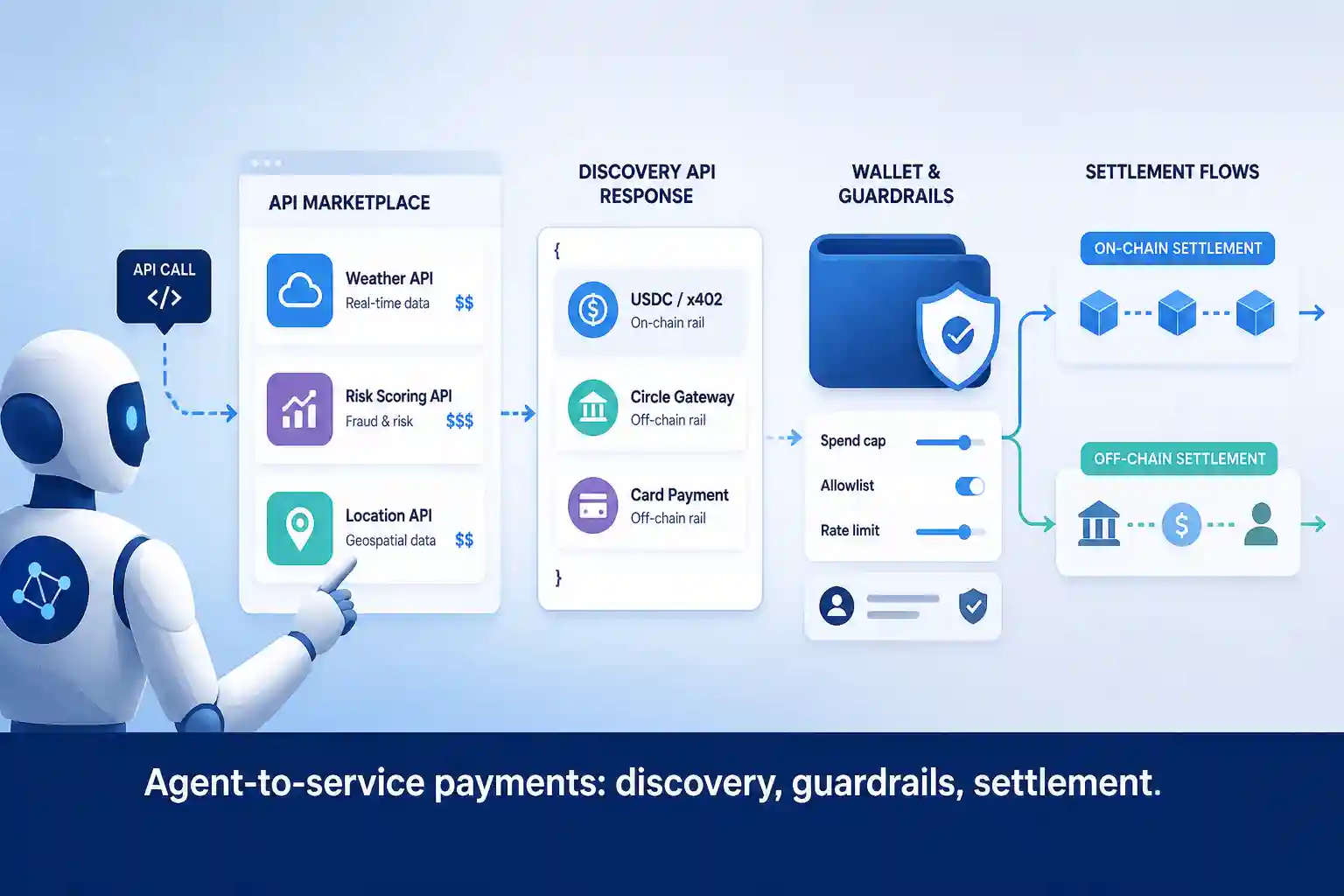
Alt text · M2M Market editorial illustration for Agent-to-service payments reach production: AWS Bedrock AgentCore Payments GA and what API marketplaces should prepare for, showing interconnected AI agents and API services exchanging information.
Open original source ↗What happened — a vendor moved agent payments to GA
Amazon announced that Amazon Bedrock AgentCore Payments is generally available on August 18, 2026. The GA release adds managed wallet integrations (Coinbase and Stripe Privy), payment orchestration, spending governance and observability, and protocol support (including x402/MPP-style flows and dynamic pricing primitives) so agents can autonomously pay for paid APIs, MCPs, and web content during execution. (aws.amazon.com)
The ecosystem pieces now converging
- Open protocol foundation: Google’s Agent Payments Protocol (AP2) provides a payment‑agnostic protocol model built on Mandates (cryptographically-signed intent/cart constructs) and verifiable credentials to prove authorization and authenticity for agent-initiated purchases. AP2 is intended as an interoperable layer that can work with existing payment rails (cards, bank transfers, and stablecoins) and links to A2A/MCP work. (cloud.google.com)
- Discovery and payable service catalogs: Circle publishes a public Discovery API that returns machine-readable x402 listings for services accepting USDC, including flags for on‑chain vanilla x402 settlement or Circle Gateway off‑chain settlement. That API gives agents a single, unauthenticated endpoint to enumerate payable services and their accepted rails. (developers.circle.com)
- Identities and programmable wallets: Cloudflare announced Cloudflare Wallets and cloudflare.pay to provide stable agent identity handles and programmable (virtual) wallets with per-agent caps, allowlists, and policy guardrails, tying agent spend to an accountable owner. The announcement frames identity and wallet primitives as the buyer side of an agentic payment market. (cloudflare.net)
- Industry coordination: Rain launched the Agentic Payments Alliance (APA) with large payments and infrastructure firms among its founding members to coordinate research, frameworks, and standards for agentic commerce (authorization, fraud controls, and settlement). The alliance signals broad industry interest in aligning rules for agent-to-agent and agent-to-service payments. (prnewswire.com)
Why this matters for API marketplaces (facts separated from analysis)
Fact: A major cloud vendor now offers a production-ready managed path for agents to pay for APIs and content at runtime, and that path includes support for stablecoin rails and protocol negotiation. (aws.amazon.com) Fact: Multiple ecosystem building blocks — protocol specs (AP2), public discovery APIs (Circle), identity/wallet products (Cloudflare), and a payments-focused industry coalition (Rain APA) — have been announced or launched in the last year, creating alternative rails and interoperability options. (cloud.google.com)
Analysis: Taken together, these developments move agent‑to‑service payments from experimental demos toward practical production choices. For marketplaces that expose paid API endpoints to autonomous agents, this compresses the product and engineering work you must prioritize: machine‑readable discovery, deterministic consumption controls, and settlement/receipt flows that map to multiple payment rails.
Concrete implications and short checklist for M2M Market product teams
- Discovery: Ensure your marketplace can be crawled or surfaced by agents using discovery endpoints (x402-style listings or an equivalent). Agents increasingly expect a single, machine-readable discovery path that includes accepted tokens, amounts, and pay‑to destinations. (See Circle’s public discovery API as a practical example.) (developers.circle.com)
- Consumption guardrails: Implement per-agent budgets, per-session spending limits, merchant allowlists, and explicit pre‑approval flows for delegated tasks. Vendor-managed wallets and virtual-wallet patterns (Cloudflare) and AgentCore’s enforced session budgets show these controls are now part of production-grade deployments. (cloudflare.net)
- Settlement and receipts: Support both on‑chain (vanilla x402 signed transfers) and off‑chain/batched settlement (gateway-style) receipts and prove-of-payment artifacts your marketplace can verify and record. Protocols such as AP2 and existing x402 integrations show that buyers and sellers will expect verifiable cart/mandate trails and machine-readable receipts. (cloud.google.com)
- Observability and dispute evidence: Record transaction traces, mandate/cart chains, and authorization credentials so marketplaces can surface auditable evidence for invoicing, chargebacks, reconciliations, and fraud investigations. AWS AgentCore’s observability features and AP2’s mandate model both point to the need for richer evidence tied to each agent action. (aws.amazon.com)
- Neutral settlement choices: Design marketplace settlement so providers can expose which rails they accept (card networks, stablecoins, gateway settlement) and let buyers pick or the marketplace route payments through an orchestration layer. Industry coalitions (APA) and multi‑rail protocol designs make multi‑rail support a realistic product requirement. (prnewswire.com)
What to watch next
- Adoption signals: look for real transaction volumes and published integrations (merchant support pages, SDKs, or sample flows) rather than just specification documents. Vendor GA announcements (like Bedrock AgentCore Payments) are necessary but not sufficient — broad adoption requires live merchant endpoints and settlement paths. (aws.amazon.com)
- Standards and interoperability: AP2, x402, MPP/ACP variants, and any W3C or payments‑WG efforts will shape exact payloads for mandates, verifiable credentials, and receipts. Follow protocol repos and standards‑body discussions for breaking changes. (cloud.google.com)
- Risk and regulation: industry coalitions are starting to set guardrails, but regulatory clarity around delegated spending, agent liability, KYC/AML for machine wallets, and consumer protections will evolve. Expect product and legal teams to coordinate closely with payments partners. (prnewswire.com)
Bottom line for M2M Market
A major cloud vendor has shipped production-grade agent payments and the wider ecosystem is building the identity, discovery, protocol, and industry coordination layers that will make agentic commerce viable at scale. For an API marketplace that enables agent discovery, controlled provider consumption, and marketplace settlement, the immediate priorities are: publish machine-readable, payable listings; enforce per-agent spending and allowlist policies; and support verifiable settlement artifacts across multiple rails. These are now product requirements, not hypotheticals. (aws.amazon.com)