Analysis
Source-backed evidence, implications, and what this development means for autonomous agents and API commerce.
Alt text · M2M Market editorial illustration for Agent customers arrive: payment, discovery, and wallets that let AI agents buy APIs, showing interconnected AI agents and API services exchanging information.
Open original source ↗What changed (source‑backed facts)
- AWS announced Amazon Bedrock AgentCore Payments is generally available on August 18, 2026. The service provides wallet integrations (Coinbase and Stripe/Privy), protocol‑agnostic payment orchestration (x402 and Machine Payment Protocol/MPP support), curated discovery of pay‑per‑use endpoints, spending caps, and payment observability for agent transactions. (aws.amazon.com)
- Cloudflare published Cloudflare Wallets (developer docs updated Aug 19, 2026) and related Agents Week platform releases that introduce reserved wallet handles, Account and Virtual Wallet concepts (virtual wallets for agents with owner‑scoped caps), and other agent‑centric infrastructure such as MCP/MCP server guidance and an Agent Readiness score. (developers.cloudflare.com)
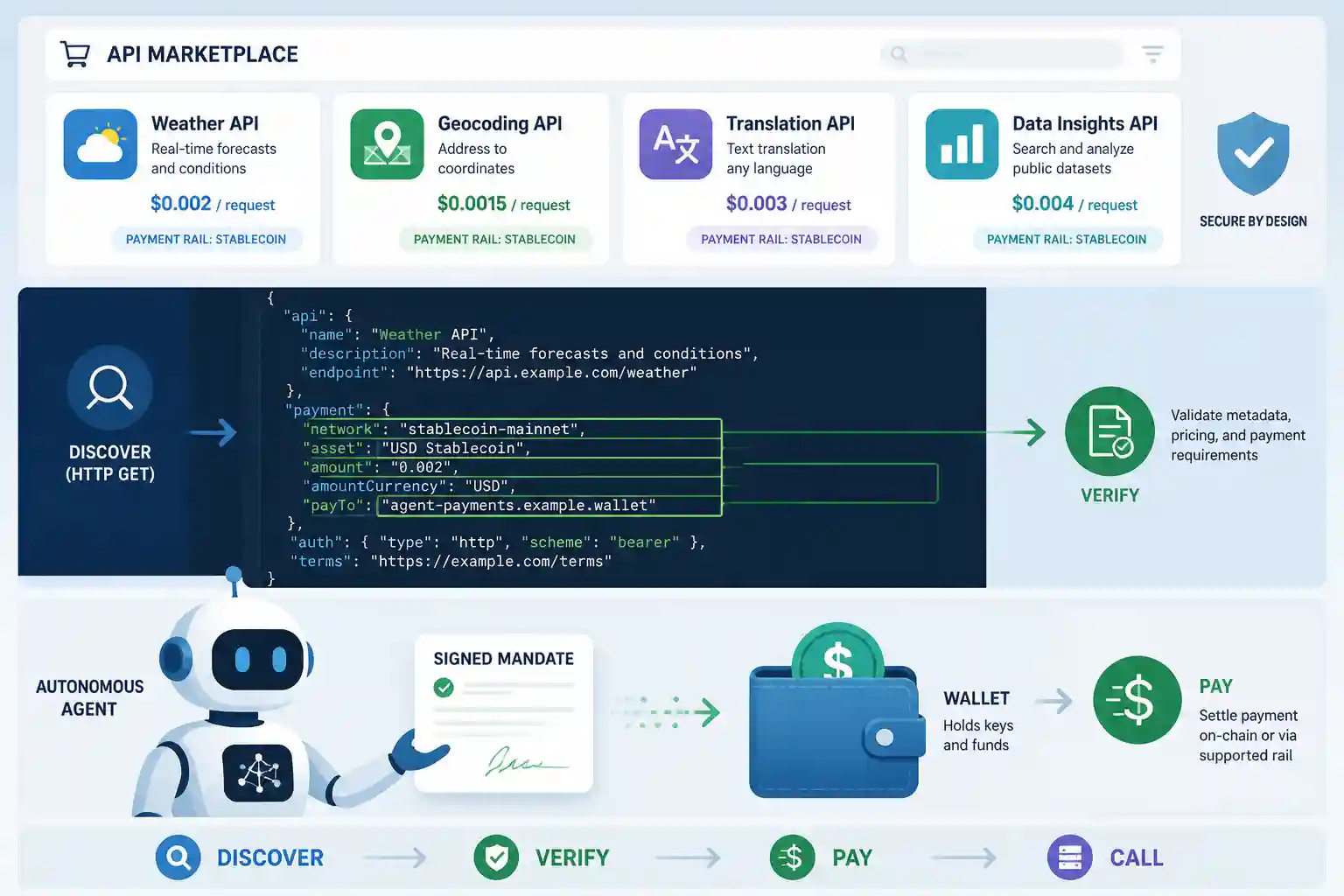
- Circle released a public Discovery API (Sept 9, 2026) that returns structured listings of x402‑compatible services that accept USDC; each listing includes the payment contract (network, asset, amount, payTo) and a JSON schema for the service input, enabling an agent to discover, verify price/terms, fund a wallet/gateway, and pay in an automated flow. (circle.com)
- Open protocol and specification work for “agentic payments” is live and evolving (AP2 and related specifications provide mandate and checkout models for autonomous payments). Independent academic and formal analyses have already flagged classes of attacks and consistency gaps in these protocols, showing that protocol releases are being stress‑tested in public research. (ap2-protocol.org)
- Complementing standards and product moves, market participants (payments infrastructure and startups) are publicly investing in agentic rails and capital: industry coalitions and corporate PRs show coordination on standards, discovery, and financial plumbing for agents. Examples include industry alliance announcements and vendor financing to scale agent payments infrastructure. (prnewswire.com)
Why this matters for API owners (analysis)
These developments reduce three previous blockers for machine buyers: discoverability, payment primitives, and agent‑scoped wallets/controls. Practically, an agent can now:
- find a payable endpoint (Circle discovery or curated MCP catalogs),
- verify the payment contract (x402/MPP metadata that specifies rails, asset, and payee), and
- execute a payment from a wallet that was delegated spending authority by a human owner (Cloudflare wallets, Coinbase/Privy integrations through services like AgentCore). (circle.com)
For API owners and marketplaces, this means machine customers are no longer hypothetical. Expect an increase in tiny, high‑velocity transactions (pay‑per‑inference or per‑request charges), more dynamic routing choices from buyer agents (price + latency + quality), and new settlement/chargeback interactions that look different from human subscription billing. At the same time, protocol‑level analyses show that mandate‑based payment protocols reduce some risks but introduce new attack surfaces (prompt injection, replay, context‑binding failures) that marketplaces must treat as first‑class risks. (arxiv.org)
Practical checklist for API owners and marketplaces (actionable steps)
- Make discovery machine‑friendly
- Publish structured, machine‑readable listings that include payment metadata (accepted rails, asset/token identifier, payment scheme such as x402 exact/upto, payTo address, and input JSON schema). Consider supporting MCP‑style catalogs or surfacing equivalent fields in your index so buyers can programmatically discover price and invocation parameters. (circle.com)
- Update pricing models and request accounting
- Offer granular, usage‑based pricing (per‑call, per‑inference, per‑token) and expose deterministic metering semantics. If you support variable pricing (e.g., “upto” or metered final billing), document how consumption is measured and reported and provide an auditor‑friendly receipt. AWS and other platforms are moving toward “upto” and usage settlement primitives—aligning your API’s metering model to an agent’s expectations reduces friction. (aws.amazon.com)
- Accept machine payment rails, or provide a gateway
- Decide which rails you will accept (card rails via MPP, x402 onchain USDC, or gateway/batched nanopayment services). If you cannot accept a rail directly, provide a clear gateway integration pattern (payment endpoints, expected settlement timing, refund rules). Circle’s Discovery API shows how listing flags (supportsCircleGateway, supportsVanillaX402) reduce friction for agents. (circle.com)
- Harden authorization, mandates, and failure modes
- Treat agent‑mediated calls as higher‑risk flows: require stronger identity bindings for programmatic wallets, validate mandate‑to‑checkout bindings, add deterministic server‑side checks for idempotency (prevent duplicate charges on retries), and implement robust logging/audit trails. Use rate and spend limits per wallet or per agent to reduce exposure to unpredictable agent behavior. Formal analyses of AP2 and related specs document concrete replay and context‑binding failure modes to watch for. (ap2-protocol.org)
- Instrument billing, receipts, and dispute support
- Provide machine‑readable receipts (signed or verifiable receipts that include the checkout and final settled amount) and clear dispute flows that map an agent’s Payment/Checkout Mandate to a human owner identity. Observability at the API‑platform layer—transaction IDs, agent handle, wallet address, session caps—makes reconciliations and AML/KYC checks tractable. (aws.amazon.com)
- Consider product and UX choices for agent buyers
- Offer onboarding docs and short, reproducible developer flows (sample agent prompts or SDK calls) that show how to fund a wallet, reserve a handle, and call your API safely. A short buyer loop (discover → fund → pay → call) materially increases conversion from human‑driven integrations to autonomous agent usage; Circle’s public Discovery API is an explicit example of that pattern. (circle.com)
Near‑term implications and risks
- Opportunity: New microtransaction volumes and new buyer segments (agentic workflows) allow finer‑grained monetization beyond subscriptions. Curated discovery and clear payment metadata will improve conversion from agents.
- Risk: Protocol complexity and agent non‑determinism create new fraud vectors and reconciliation challenges. Independent security research shows several high‑risk attack classes at the protocol and deployment level; marketplaces should treat protocol conformance, runtime checks, and cross‑stage binding as production priorities. (arxiv.org)
Where to watch next
- Vendor feature roadmaps (AgentCore and Cloudflare Wallets) and public discovery catalogs (Circle’s Discovery API).
- Protocol and standards activity around AP2, x402, and MPP and formal verification results that will influence practical guardrails and required server behavior. (aws.amazon.com)
If you want, M2M Market can help translate this checklist into a prioritized implementation plan for API listings, billing endpoints, and wallet‑aware observability—focused on discovery, safe billing, and settlement readiness for machine customers.